The heart that refused to grow old
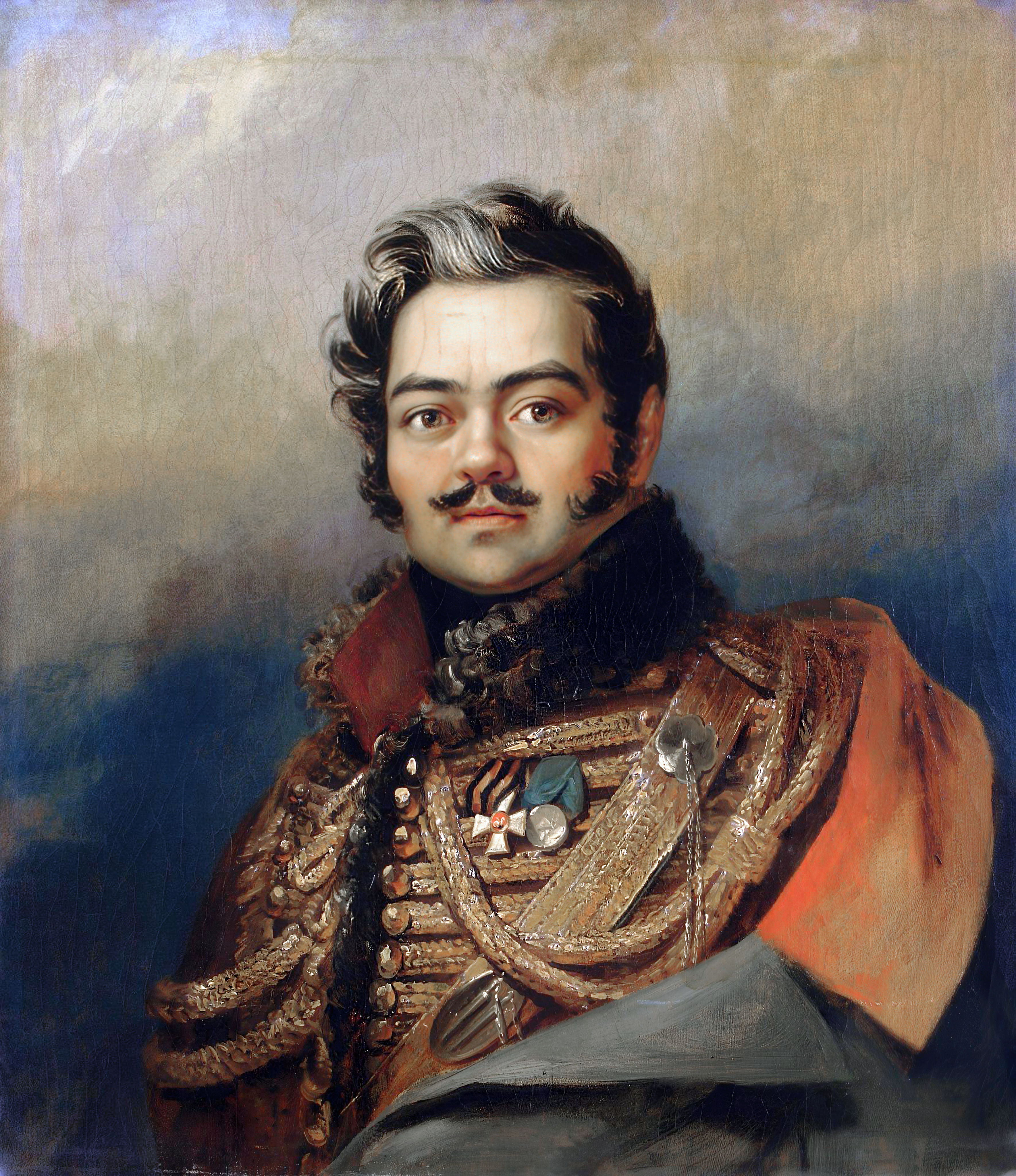
There are people history remembers in a single pose. Denis Davydov remains forever in uniform: dark curls, a defiant gaze, hussar moustache, one hand near the sabre. A hero, a cavalryman, a lover of risk, hunting, wine and a well-aimed phrase. It feels as though we know him before opening a single page of his poetry.
But that image is only half the truth.
Behind the public legend was a man who feared not death so much as inner silence. He needed his heart to beat faster than usual. In peaceful life he sought that intensity in friendship, beauty, love and poetry. When one source disappeared, he searched for another. That is why it is so difficult to separate the warrior from the poet, emotion from performance, and the living man from the figure he consciously created.
This project travels toward another Davydov: no longer young, often tired and unwell, convinced that the essential part of life might already be over — and suddenly discovering that his heart was still capable of youthful recklessness. The guide into this story is Evgenia Zolotaryova, a woman about whom history preserved far less, yet without whom one of the strongest late flowerings of Russian love poetry would not exist.
Penza: poetry returns
In 1831 Davydov retired with the rank of lieutenant general and settled with his family at Verkhnyaya Maza. Youth had receded. His health reminded him of his age. He was married to Sofia Nikolaevna Chirkova and was the father of a large family. His life appeared to have entered a quiet final chapter.
But the heart had a design of its own.
Davydov often travelled to Penza. In winter the provincial city entered its social season: assemblies, balls, theatre, concerts, visits, dinners, hunts, rumours and intrigue. For a man living on a country estate, it was a return to movement.
There, in December 1833, Evgenia Dmitrievna Zolotaryova became the centre of his attention. Born in 1810, she was nearly twenty-six years younger than Davydov. Contemporaries called her beautiful, yet his poems offer almost no portrait. We do not receive the exact colour of her eyes or the line of her face. Instead, we witness the effect she has upon the poet: space begins to move, the crowd parts, blood runs faster, and a silent source opens again.
Zolotaryova entered his poetry not as a motionless muse upon a pedestal, but as a force of awakening.
The reopened source
After the winter of 1833–1834 Davydov wrote to Alexander Pushkin that the strings of his heart had begun to sound again and that poems had burst from him. To Pyotr Vyazemsky he was even more direct: Zolotaryova seemed to have reopened a source that had fallen silent.
These words contain more than romantic excitement. They carry the astonishment of a person who had decided poetry had left him forever and then suddenly discovered himself alive.
The ballroom replaced the open field; the waltz became a rush of movement; a woman passing through a crowd acquired the speed of a rider in flight. Even Davydov’s love poems retain the kinetics of an intensely physical man: everything races, boils, flies, breaks through. His tenderness is never still. It moves with the same velocity as his public legend, except that now the word has taken the place of the sabre.
Thus appeared the late Zolotaryova cycle: eighteen works written between 1834 and 1836, the largest sustained love cycle in Davydov’s poetry. Among them are The Waltz, The River, My Little Star, A Note Sent at a Ball, 25 October, After the Separation, Recovery and other poems. Some speak in rapture, others in jealousy, anxiety or anticipated loss. Together they form not an album of compliments, but an emotional narrative.
Love — or the art of being in love?
This is where the romantic legend meets the documents.
Later retellings often shape the episode into a ready-made novel: an ageing hero encounters his final love; the young beauty returns his feeling; society and circumstance separate them; she marries another man, while he carries the memory to the end of his life. It is a beautiful story — and an easy one to turn into music.
The surviving letters do not allow us to tell it with such certainty.
Davydov was undoubtedly captivated by Evgenia — or at least by the state of being that emerged in her presence. He dedicated poems to her, travelled to see her, maintained a correspondence and remembered his Penza years as a period of happiness. More than fifty letters from him were once known to have existed. Zolotaryova’s own voice, however, has almost entirely disappeared. One surviving fragment suggests that she offered friendship and asked him to abandon the excessive passion of his language.
Was it a mutual romance? A Platonic attachment? A social courtship that became more serious for Davydov than he intended to admit? Or an encounter between a real woman and an image the poet needed in order to write again?
The honest answer is that we do not know.
That uncertainty is what keeps the story alive. Evgenia should not remain a silent reward handed to a famous man. She had her own reputation, future and boundaries. Davydov, meanwhile, was a husband and a father. Real life was more complicated than the later legend of two solitary hearts.
Perhaps Davydov loved not only Evgenia, but also the self he became beside her: young again, inspired again, able to write. Perhaps he knowingly performed the familiar role of the hussar and admirer of beauty. Yet art is often born precisely where performance unexpectedly becomes truth. A person puts on a mask — and through it says what he could never have spoken in his own name.
What remained
By 1836 the Zolotaryova chapter was ending. Evgenia Dmitrievna married Vasily Matsnev, a landowner and retired dragoon officer. Public gossip may also have played a part: a private attachment had become visible enough to enter the conversation of provincial society.
Davydov’s later words about Penza sound like a farewell not only to a woman, but to an entire period of his life. There remained his journeys, friends, hunting, love — and, as he wrote, all his poetry. He seemed to understand that he was losing more than the possibility of seeing Evgenia. The source that had briefly returned a vanished part of himself was closing.
After their separation his lyrical voice almost fell silent. Davydov died in 1839, only a few years after the cycle ended. Zolotaryova outlived him by decades. We know far less about her later life, and that imbalance of memory is telling: history preserved the emotions of the celebrated poet in detail, but only fragments of the woman’s voice that awakened them.
And yet she did not disappear. Evgenia remains in the movement of the poems: in the noise of trees, the current of a river, the whirl of a waltz, the anxiety of meeting and the pain of a name one forbids others to speak precisely because it cannot be forgotten.
Two hearts
The title Two Hearts does not refer only to Davydov and Zolotaryova. Davydov himself seemed to possess two hearts.
One belonged to action: restless, physical, drawn toward risk, motion, friendship and glory. The other belonged to poetry: vulnerable, dependent upon memory, beauty and another person’s gaze. The first made him a public figure. The second prevented that figure from becoming a bronze monument.
Perhaps, however, it was always one heart demanding intensity. When one kind of intensity disappeared, it found another in language and love. The Zolotaryova cycle is therefore not a sentimental footnote to a more important biography. It continues the inner story of a person who did not know how to live by halves.
Today these poems return as songs. Not to dress Davydov in modern clothes, and not to turn his life into costume melodrama. The music searches the old lines for what belongs to no single century: the fear of inner silence, the sudden return of feeling, the uncertainty between friendship and love, the artist’s dependence upon inspiration, and the memory of a name that survives the relationship itself.
This is not a museum story about a famous man and a beautiful woman. It is a story about surviving one’s own youth and the conviction that everything important has already happened — then entering a brightly lit room, seeing a familiar face in the crowd, and hearing the long-silent strings of the heart begin to sound again.
That sound is where our cycle begins.
Documents behind this essay
These links lead to museum, library and research records, separating documented images and evidence from later legends and mistaken attributions.
- 01Penza Literary Museums: Denis Davydov ↗
- 02Larisa Rasskazova. Denis Davydov and Evgenia Zolotaryova: great love or performance? ↗
- 03Russian Virtual Library: notes on illustrations and manuscripts ↗
- 04D. V. Davydov. Poems. Poet’s Library edition, 1984 ↗
- 05Virtual Russian Museum: Davydov portrait by Karl Hampeln ↗
- 06Virtual Russian Museum: Davydov portrait by A. Afanasyev ↗
- 07Wikimedia Commons: George Dawe portrait, public domain ↗
- 08Wikimedia Commons: Denis Davydov signature, public domain ↗
- 09Culture.ru: Davydov and his late muse ↗