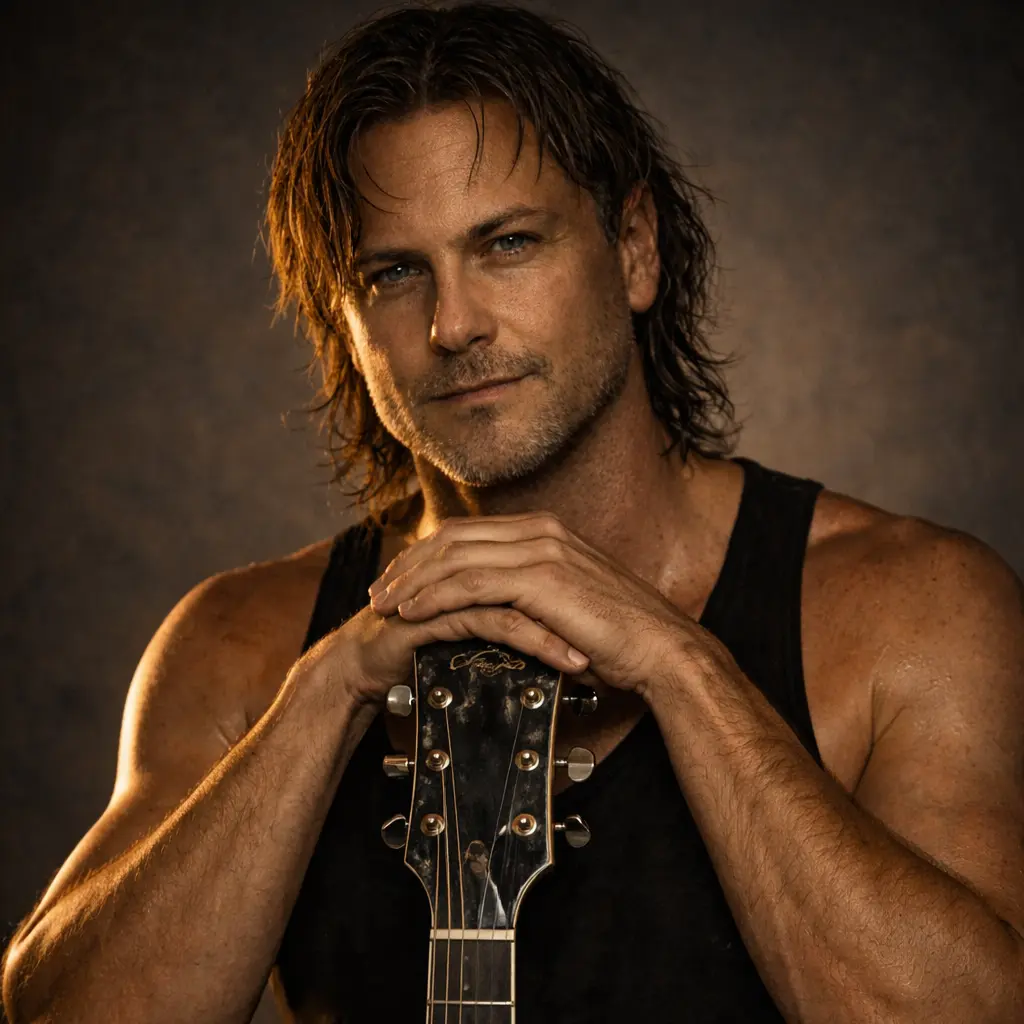
Forever In My Heart
Not an attempt to restore the past, but an admission of memory, responsibility and regret.
01Forever In My Heart
+
This song is not an attempt to bring someone back from the past.
It is about returning to one particular moment in my own life and admitting honestly: I was wrong.
02An Ordinary Evening After a Show
+
It was one of those familiar evenings after a concert, when you can finally breathe for a while—sit in the hotel lobby, meet other musicians, go to the bar and talk. Admirers surround you, you are at the centre of attention, and your own stardom has begun to go slightly to your head.
At that time, I performed under a stage name. Its two initials gradually became a name of their own, one the girls used for me: Dizzy.
One of those girls was especially taken with me. She was beautiful, easy to talk to and genuinely wonderful. I liked her. We were intimate.
But the two of us understood that intimacy in completely different ways.
03Freedom Without Promises
+
For me, our meetings did not mean the beginning of a serious relationship.
I fell in love easily. I could become consumed by a new attraction very quickly, but I did not want to stop with one person. Today there was one city; tomorrow, another. There might be one wonderful girl in this city and another wonderful person waiting in the next.
I was attracted to both women and men. I did not want to choose, define the boundaries of my life or make promises to anyone. I had consciously chosen freedom.
Today I understand that she expected far more from our meetings than I did. Perhaps I saw it even then but preferred not to think about it. What we had suited me as long as it required no decision from me.
04Two Letters
+
That evening, after the show, we were sitting in the hotel lobby. She was there too.
At the first opportunity, she showed me a tattoo on her chest: the two initials of my stage name. Everyone around us knew what they meant and who they were dedicated to. I knew too, of course.
What did I feel? Looking back after all these years, I can call it fear.
Until that moment, our relationship could remain light, temporary and free of obligation. The tattoo suddenly made visible everything I had refused to discuss. For her, our meetings had already become part of something much greater.
To me, it felt as though her decision now placed an obligation on me—as though someone had come too close, laid claim to my freedom, and expected me to belong to them.
I was frightened.
05Coldness as a Defence
+
Instead of saying honestly what I felt, I answered with coldness and irony.
I looked at the tattoo, pretended not to understand, and asked:
“What is that supposed to be?”
I knew perfectly well what it was.
I saw her embarrassment. I saw her tears. Then she left.
Perhaps I believed I was simply protecting my freedom and drawing a line she could not cross. Now I understand that my fear does not erase the pain I caused.
I was not cold because I felt nothing. Perhaps the opposite was true: I felt too much and became frightened by the meaning I gave her gesture.
That explains my reaction. It does not make it right. I had no right to humiliate someone for feelings I could not return.
06The Next City
+
Soon afterwards, we left. The tour continued: other cities, performances, people and new attractions lay ahead.
We lost each other.
Social media was not yet the natural part of life it is today—at least not of mine. I had an email account I could leave unopened for years. My phone numbers changed constantly because I regularly lost the phones themselves. Contacts disappeared, cities replaced one another, and a person could simply fall out of your life forever.
For a while, I did not return to that meeting in my thoughts. I believed it had remained far behind with so much else.
But some memories never disappear. They simply wait until you are finally ready to look at them honestly.
07When My Life Hung by a Thread
+
In 2017, my life hung by a thread.
When you come too close to the possible conclusion of everything, you begin to see differently the way you lived, the things you said and the pain you left behind.
I had to reconsider absolutely everything—first of all, my relationship with life and with myself.
That night was not the only time I pushed away someone who was close to me. Life later gave me the chance to meet and speak with many people from my past. I admitted that I had been harsh. My former partners built families and lives of their own. Some still ask me for advice; some I occasionally meet. The past was spoken about and no longer hurt in the same way.
But this story remained unfinished.
I still do not know why it stayed so deeply embedded in my memory. Perhaps because the situation itself was so unusual. Perhaps because everything ended too abruptly. It felt like a stone I carried inside and could never put back in its proper place.
There is a time to scatter stones and a time to gather them. In 2017, my time to gather them had arrived.
08Not an Attempt to Return
+
I do not want to interfere with her life today.
She may have an entirely different destiny now—a relationship, a family, joys and difficulties of her own. I have no intention of appearing without warning, disrupting anything or demanding an answer.
This song is not an attempt to restore the past.
I wanted to change only one situation: what happened that night in the hotel. Of course, it can no longer be changed. But I can stop pretending that nothing happened.
I can admit:
I knew what those letters meant.
I saw your feelings.
And I should never have hurt you that way.
Sometimes an apology comes too late to change the past. Perhaps it is not too late to stop hiding from it.
09The Song We Chose Not to Give Away
+
My little swallow has always known about my stories, infatuations, mistakes and adventures. We spoke often about my past, my present and what the future might become. The story of that girl became part of those conversations too.
It was my swallow who suggested turning this admission into a song. She began writing its first words.
At that time, she wrote many songs for other performers. Forever In My Heart was also intended for another artist and would probably have been given away or sold.
Then one day I picked up a guitar and began to sing it, sitting at a table almost by accident. These were among my first attempts to hold the instrument again.
The words changed a little. The melody changed a little. The song gradually adapted to my voice and to what I truly needed to say.
My little swallow decided we could not give it away:
“We will write another hundred songs. That is not a problem. But this one stays with you.”
I had no plans to perform or record it, and I was not even sure I would ever return to music. It remained there—once played on a guitar and sung at a table. Years passed.
10What the Title Means
+
Perhaps the song was simply waiting for the moment when its words needed to be heard.
Some things cannot be said in an ordinary conversation. Perhaps you no longer have a telephone number, an address, or the right to appear unexpectedly in someone else’s life.
But a song remains.
The first step is to recognise what happened, say it aloud and release it. The second is to allow someone else to hear those words. And if they one day reach the person for whom they were truly meant, that will be almost a miracle.
The title Forever In My Heart does not mean that I am still waiting for her or want our relationship back.
Some people remain inside us in another way: as part of our life, our memory and our responsibility. As a reminder of who we once were—and of the person we decided no longer to be.
11Our First Restoration
+
Forever In My Heart became the first song we approached specifically as restorers.
It had been recorded a long time ago. Our task was not to recreate it, modernise it or turn it into a different work. On the contrary, we wanted to preserve everything that lived in the original recording: its mood, phrasing, melody, inner movement and the moment in which the song had first appeared.
With the help of artificial-intelligence tools, we carried out a complete restoration of the recording.
It was an unusual and deeply responsible process. Every technical intervention could improve the sound, but it could also accidentally alter what made the song alive. Each decision therefore had to be made with great care: recover what had been lost, remove what prevented the original recording from being heard, but never draw a new story over it.
12Like Restoring a Fresco
+
While we were working, a good friend of mine came to visit. He is an artist who has spent many years restoring old frescoes and working with icon painting.
He watched us work with the old recording and became completely absorbed in the process. After a while, he said:
“Now I understand how similar our work is.”
He also uses artificial-intelligence tools in his restoration practice. He photographs surviving fragments of frescoes, examines them digitally, and uses the resulting analysis to help recover lines, original colour relationships and the structure of the painted surface. The technology does not make the artistic decision for the restorer. It helps reveal what has nearly disappeared, compare fragments and approach the original image with greater care.
Watching us, he recognised the same principle.
We were not trying to create a new song on top of the old one. We were carefully reaching for what was already inside the recording—not replacing it with a modern sound, but helping its original voice become audible again.
The comparison felt exactly right to me. A fresco restorer must not leave a new painting of their own on the wall. The task is to return to the viewer the work that existed before the restoration began.
Artificial intelligence was used here in the same spirit: not to rewrite Forever In My Heart, but to preserve it and allow an old recording to sound again.
This song became our first restoration project—our first swallow in an entirely new creative process.
13The Words I Should Have Said
+
I do not know whether she will ever hear Forever In My Heart. I do not know whether she will recognise herself in this story. And I do not expect an answer.
This song asks for nothing.
It says only what I should have said many years ago:
I remember.
I understand what I did.
And I am sorry.
Some words cannot change the past.
But sometimes they can change the person who finally finds the courage to say them.
— Alex Kryve