For me, this subject is part of my everyday work. I work on the musical concepts for series, animated films, and television programs. This is my main professional activity, and artificial intelligence tools have been part of that work for some time. When I read news about new technologies, I recognize familiar production tasks, creative searches, and decisions that shape the finished sound.
Speaking openly about the use of AI can still be difficult. A discussion of specific work can all too easily give way to a sweeping judgment: if artificial intelligence was involved, everything must have happened by itself. That assumption obscures the knowledge, trained ear, performance experience, and time of the people who work with these tools and learn every day to use them more precisely.
That is why I pay attention when major companies, including Disney, publicly discuss the use of AI in their projects. To me, this suggests that the professional conversation is changing. There is more room to discuss particular technologies and tasks, explain their role in production, and show the work people do behind the finished result.
That is what I want to examine in this article: how music for the screen takes shape, how many decisions it requires, and why pressing a button cannot describe all that work.
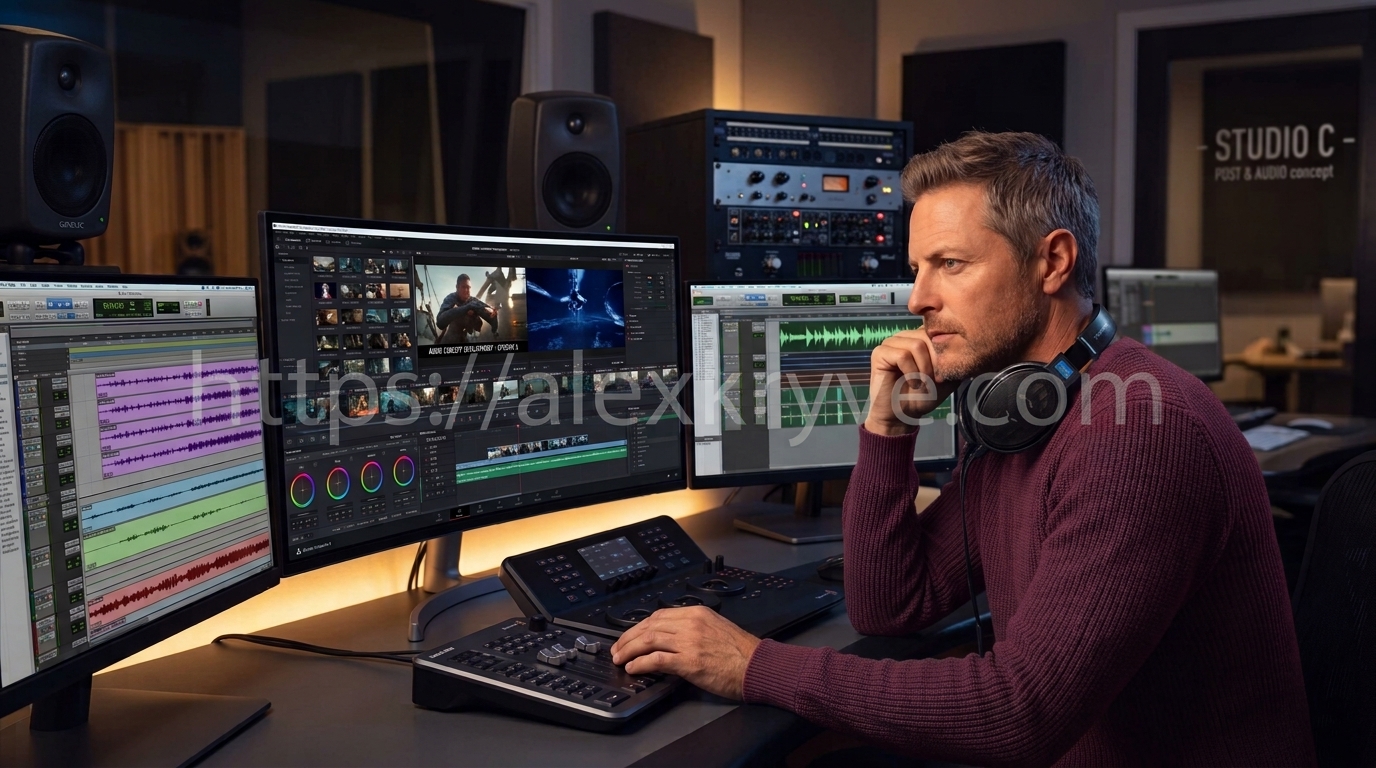
A composer searches for the musical inflection that will open a scene. Sometimes it emerges in a few notes played on a keyboard; sometimes in a voice memo recorded on the move. The harmony changes, the rhythm becomes more precise, and instruments enter the arrangement. A singer tries a phrase, stops, and returns to a word that needs a different delivery. A recording engineer assembles the performance, and in the editing room the music meets the picture and the actors’ dialogue. Here, a beautiful musical passage may turn out to reveal a resolution too early or obscure a quiet but important word.
This is how a soundtrack gradually takes shape. Artificial intelligence enters different stages of that work: separating recordings, processing voices, and proposing instrumental parts and sound effects. To understand its contribution, we need to follow the process. A button in an interface shows the moment an operation begins. Beyond that button lie preparation, musical decisions, listening, revisions, and responsibility for the finished work.
In the first part of this study, we examined artists’ work in visual production. We now turn to music and sound: what is documented in Disney projects, what contemporary tools offer, and how to describe human contributions precisely enough to keep them visible.
How Music Becomes Part of a Scene
A soundtrack brings together different kinds of work. A song may have its own lyrics and melody before becoming part of a film. An instrumental score develops alongside the action. Footsteps, breathing, room ambience, and characters’ voices present another set of tasks. In the finished film, these elements coexist, so one specialist’s decisions affect everyone else’s work.
Imagine a reunion after a long separation. The composer might emphasize joy immediately or leave the first seconds without music: the audience needs to hear someone struggling to speak. A performer can express that pause through breathing. The mix must preserve its audibility. If the director later shortens the scene, the musical transition will need to change again. This is a hypothetical example, but it shows why accompaniment cannot be assessed solely by the beauty of a standalone track.
A concrete account of musical work appears in the official feature on the score for The Mandalorian and Grogu. Ludwig Göransson discusses revisiting established themes and finding new sounds. The film brought together a 106-piece orchestra and a 64-person choir, while the familiar bass recorder remained part of its musical language.[1]
That publication describes compositional and performance decisions. It is not a technical audit of the entire production and cannot establish that machine learning was absent from every stage. It does, however, give audiences specific names and actions that explain how the music was made. Accounts of AI deserve the same specificity.
What Disney Music Group Actually Does With AI
One of the clearest examples involves AudioShake. In an announcement dated July 15, 2024, Disney Music Group and AudioShake described an expanded collaboration on separating musical recordings into components and automatically transcribing lyrics. The announcement identifies a problem in the older catalog: some recordings lack the separate components needed for new uses. The stated possibilities include remastering, synchronization with picture, immersive audio, and lyric videos.[2]
This helps us ask a precise question. There is a work that people have already written and performed. There is a finished recording in which voices and instruments are combined. Technology makes it possible to work with that recording in new ways. An accurate description should identify the processing of existing audio and the people making decisions afterward.
The same agreement covers lyric transcription. Automatically recognized words can assist with metadata and music videos. A useful transcription tool does not become the author of the lyrics, however. Its output still needs checking, particularly where there is unusual diction, overlapping voices, names, or archaic language. This is a practical inference about reviewing transcriptions, not a published report of errors at Disney.
The public account does not list every processed song or provide a complete record of manual revisions. It therefore establishes a particular technological practice without allowing us to calculate AI’s share of all the company’s music.
What Happens When a Recording Is Separated
A studio project may contain separate recordings of vocals, guitar, drums, and other sources. A finished stereo mix combines them. When the original project is lost or unavailable, a separation system estimates which elements belong to the voice, bass, percussion, or other groups.
The resulting files are commonly called stems. In production, that word also refers to submixes deliberately created from the original session tracks. The distinction matters: files extracted from a finished mix should not automatically be treated as exact copies of the original studio recordings.
A useful explanation of the limitations appears in iZotope’s tutorial on Music Rebalance. The developer describes a tradeoff: more selective separation can introduce unwanted artifacts, while gentler separation may leave elements of one instrument in another group. The page includes audio comparisons of different settings. It concerns RX 7 and is used here to explain the principle, rather than to assess every contemporary system.[3]
Suppose a processed voice seems clean while the whole ensemble is playing. Solo the vocal, and an unwanted trace becomes audible on a sustained note. Elsewhere, removing an instrument also removes part of a consonant. These are hypothetical quality-control situations. The engineer must decide where processing helps, where to reduce it, and where to preserve an original passage.
The painstaking work lies in hearing a small defect, understanding its cause, and choosing a correction that does not damage the performance. Even a short automated operation may require extensive checking. The reverse is also possible: on suitable material, a tool can save substantial time. Processing time alone does not describe an artistic contribution.
What the Story of Now And Then Shows
A revealing example outside Disney is The Beatles’ Now And Then, released in 2023. According to the official account, the MAL system developed by Peter Jackson’s team helped separate John Lennon’s voice from the piano in his home recording. The musicians then continued the work, incorporating George Harrison’s 1995 guitar parts, new performances by Paul McCartney and Ringo Starr, and a string arrangement. The published credits identify producers, engineers, the head of machine learning, and the source-separation technology.[4]
For this discussion, the way the process is explained is especially valuable. We can trace the origin of the voice, the system’s task, and the new recordings made by people. Technology helps make an existing performance audible, while subsequent work shapes the finished recording.
Such an account tells listeners much more than the general description “music with AI.” That description may accompany the discussion, but it needs detail. Otherwise, a performer’s identity and an engineer’s work disappear behind the name of a technology, even though their interaction explains the result.
Music and the Images Around It
In November 2026, Disney also announced a collaboration between Disney Music Group and OpenArt. The official statement concerns the exploration of visual concepts for lyric videos, inspired by a song’s themes, mood, and emotional tone.[5]
The context is musical, but the stated task concerns images. Generating a visual concept does not establish that a system wrote the melody, created the vocal, or replaced an orchestra. For a particular video, the origins of the audio and the visuals need to be established separately.
The same precision is needed when reading the Adobe and Disney alliance announcement of November 9, 2026. It describes, among other things, visual models and their use in park development. The presence of music tools in Adobe’s product range does not establish their use in a particular Disney soundtrack.[6]
I found no confirmation in the primary sources reviewed here of a general decision to hand the composition of all Disney music to AI. A substantive study can begin with what is documented: catalog processing, particular sound technologies, and specific production tasks. That already provides plenty of material for discussing work.
When a System Actually Creates New Music
Generating new musical material is a different situation. A system may propose a melodic phrase, accompaniment, an instrumental texture, or a complete track. Human involvement can range from accepting the first output to extensively reworking it. Using the same service does not make those methods equivalent.
Adobe Firefly’s documentation, for example, describes creating music for an uploaded video. The service analyzes the material, proposes a prompt, allows adjustments to mood, style, energy, tempo, and duration, and then lets the user compare alternatives alongside the picture.[7]
This is a documented capability of an Adobe tool. It is included as an example of an available workflow, without claiming that Disney uses it. Matching a video’s duration does not solve every dramatic problem: a musical climax may coincide with dialogue, the development may be too active, or a transition may draw unnecessary attention. Those are questions for artistic review.
A good brief contains more than genre words. It explains what happens in the scene, where the audience’s relationship to a character changes, and how the voice should fit. Wording can launch the search, but someone still needs to listen and compare the proposals against the task.
The number of attempts is not a universal measure of skill. A hundred variations may end in a selection without further changes. One carefully prepared source can become the basis of extensive reworking. What matters is the decisions retained in the result and the ability to show them.
Working Inside a Music Project
The shift toward an editable project is visible in Suno Studio. The official description of Studio 2.0 lists MIDI, effects, parameter automation, and work with separate components of a recording.[8] Its export documentation describes exporting a complete mix, a selected passage, individual tracks, and MIDI extracted from stems for further work.[9]
This is a production environment outside Disney. It is useful here because it shows how work can continue after generation. A musician can change notes, restructure a piece, replace timbres, and assemble a version of their own. The availability of these functions does not prove that every user employs them. A particular work requires particular evidence.
MIDI deserves special attention. It consists of note and control-event data that an instrument turns into sound. Extracting MIDI from audio does not by itself establish either the accuracy of the transcription or the origin of a musical idea. The resulting notes must be compared with what is actually audible and with the author’s intentions.
Imagine a song in which a composer writes the melody, a lyricist writes the words, and a singer records the lead vocal. A generative tool supplies part of the accompaniment. An arranger then changes the bass development, rerecords the guitar, shortens the introduction, and clears space before the chorus. This hypothetical process contains several distinct contributions. Each deserves a name in the account of the work.
Looking Inside One Musical Passage
To make the discussion concrete, consider a hypothetical one-minute scene. This is an illustration, not a reconstruction of a Disney production or the result of an experiment conducted for this article.
At the beginning, a character walks through an empty house. We hear footsteps and faint room ambience. At twenty seconds, the character notices a familiar object. A few seconds later, they try to speak. By the end, they decide to return to the place they once left.
The composer first decides whether the opening footsteps need music. They try a short theme and choose its entrance. Melody alone is insufficient: the same motif can suggest memory, anxiety, or a promise depending on its harmony and performance.
The search for accompaniment can involve instrumental sketches, original recordings, or a generative tool. If a system proposes a useful texture, it still needs checking against the scene. Does it obscure the character’s breathing? Does it imply danger where recognition is needed? Does its rhythmic density fit the camera movement?
The form then changes. The introduction is shortened, some bass notes are removed, and the musical response to a line of dialogue moves later. In one place, a human-recorded part works better; elsewhere, some proposed material remains. Editing possibilities differ depending on whether the source is a finished mix, separate tracks, or MIDI.
During mixing, music meets speech and sound effects. The engineer adjusts their balance over time. A beautiful detail may have to go because it interferes with the scene. A director’s revision can send the team back to a passage they had already resolved, requiring another check of the transition.
Generation occupies one part of this process. A sequence of decisions creates the finished scene. Those decisions can be almost invisible to the audience precisely when the accompaniment works convincingly.
Sound Effects Also Involve Performance
Firefly’s documentation distinguishes sound-effects generation from music and speech generation. It describes choosing variations, working on a timeline, trimming clips, adjusting volume, and combining sounds.[10]
Voice to sound effects makes the process particularly clear. A person can record a vocal guide that establishes the timing and energy of a future effect. The system uses those characteristics alongside a text description. Adobe explicitly states that this recording serves as a guide and that the function does not generate speech or sung lyrics.[11]
Here, performance conveys part of the brief. A person can demonstrate a build, an accent, a pause, or a decay. The generated sound must then be matched to the action, processed, and placed within the soundscape. These actions explain the work more clearly than talk of the “right magic words.”
Apple’s published conversations with Skywalker Sound artists describe an earlier practice: finding and recording unusual sources, transforming sounds, and choosing their emotional character. Ben Burtt recalls recording a malfunctioning fan that later contributed to a sound effect in The Phantom Menace. This account does not establish the use of contemporary generative AI; it shows the creative process into which new tools can now enter.[12]
What Skywalker Sound Research Can Tell Us
A Skywalker Sound vacancy posted on October 5, 2026 describes machine-learning work in speech processing, source separation, style transfer, upmixing, and generative audio synthesis. Responsibilities include training and validating models, optimizing them, and integrating them into production workflows.[13]
A vacancy establishes an interest in, and work on, particular technologies. It is not a list of techniques used in an already released film. Still less can it establish that the company no longer needs composers or sound engineers.
It does reveal another area of human work. Tools depend on people who prepare data, examine errors, and make systems usable in production. Recognizing that work matters, although engineering contributions and authorship of a particular musical work remain separate questions.
A Human Voice and Its Digital Replica
Processing existing singing, generating a new vocal, and reproducing a particular person’s recognizable voice require different explanations. The distinction becomes especially apparent when listeners identify a performer through vocal timbre.
In May 2025, Disney announced an interactive Darth Vader in Fortnite using an AI reproduction of James Earl Jones’ voice. The announcement emphasized consultation with the actor’s family. This is an example of speech in a game, rather than music composition or a sung performance.[14]
It matters to the music discussion because it shows the need to address a voice’s source and permission to use it separately. The technical ability to obtain a similar sound does not determine who may release that recording or under what conditions.
SAG-AFTRA’s bulletin on its sound-recordings agreement sets out requirements concerning consent to a digital voice replica, the specificity of its use, and compensation. These provisions have a contractual scope; they are not a single law covering every performer worldwide.[15] AFM’s film and television agreements ratified in 2024 also include protections concerning performances used with AI.[16]
Public promises to preserve creativity deserve examination through concrete conditions: whose consent is requested, how participation is paid, and who can challenge the use of their performance. A program’s convenience does not automatically resolve these questions.
Work and Authorship Require Different Evidence
I believe it is essential to discuss the substantial work people do with AI. To protect that work, however, it helps to distinguish professional effort, creative contribution, and legal protection. Hours spent on a project deserve attention; they do not by themselves determine copyright in every resulting element.
In its 2025 conclusions, the U.S. Copyright Office connects protection to sufficient human control over expressive elements. It recognizes that human creativity can remain protected when AI is used and separately considers creative modifications or arrangements of material. Providing prompts alone is insufficient to establish authorship of machine-generated output. This is a U.S. position and does not replace an analysis of other jurisdictions.[17]
A practical task follows for a music project: keep melodic sketches, lyrics, original recordings, arrangement versions, and a history of substantial changes. They help explain what a person created and what survived in the finished work. A service’s permission for commercial use, rights in a musical work, and rights in a particular recording also need separate consideration.
Such documentation matters for honesty toward listeners, too. If a part was generated and retained almost unchanged, it should be described accordingly. If it was extensively reworked, the nature of that reworking deserves explanation. Precision makes the protection of human work more persuasive.
What Platforms Currently Require Creators to Disclose
YouTube has a dedicated instruction for music partners that distinguishes fully generative content, partly generative content, and content without generative AI. Examples of partial use include generated instrumental layers combined with live recordings. Automated mastering and minor conventional pitch correction are given as examples of content without generative AI.[18]
The same instruction explains that accompanying AI-generated visuals can affect the classification of content even when humans performed all the audio. When discussing a label, we therefore need to identify the item concerned: a sound recording, a music video, or another resource. This is particularly relevant to the Disney Music Group and OpenArt collaboration described earlier.
YouTube’s general help page separately includes AI-generated music among its disclosure examples and distinguishes it from certain forms of repairing or enhancing previously recorded audio. The platform may also use automated signals.[19]
These provisions do not produce a universal labeling formula for every kind of processing. A particular workflow must be compared with the current rules. Nor can we promise in advance that a major studio will receive an exemption. Demonstrating unequal treatment would require comparable works and documented platform decisions.
In the EU, Article 50 of the AI Act distinguishes providers’ machine-readable marking of synthetic material from deployers’ disclosure of certain content. It includes qualifications for standard assistive editing and appropriate disclosure for evidently artistic works containing deepfakes. It does not establish one identical visible notice for every musical use of AI.[20]
Keeping People’s Names Alongside the Technology
AI disclosure should be supplemented with clear professional credits. For a hypothetical song, an account could identify who wrote the lyrics and melody, who recorded the vocals and instruments, which parts involved generation, and who performed the subsequent arrangement and mixing. Those roles must reflect the actual work, without crediting a person for something the system did.
For example: “The lyrics and melody were written by the author. The lead vocal and guitar were recorded by the performer. A generative tool was used for part of the instrumental accompaniment; subsequent arrangement, editing, and mixing were performed by the credited specialists.” This is a proposed description, not a quotation from Disney credits or a replacement for a platform’s required declaration.
Technical mechanisms for more detailed reporting already exist. DDEX standards provide fields for identifying generative AI involvement at the contributor and resource levels.[21] YouTube describes receiving such declarations from music partners. A field in a standard does not, however, mean that every distributor offers an author a corresponding interface or that listeners will see every detail.
I would like that level of detail to become a normal part of respecting creative work. When we discuss a new recording, it helps to know which expressive decisions a person made, what they performed, and how they worked with the system’s proposals. A technology’s name should help explain production.
Disney Music Group and AudioShake offer an example of work with an existing catalog. Now And Then lets us trace the separation of an archival recording and the musicians’ subsequent contributions. Generative tools demonstrate new ways to explore and process material. Each case has its own process, people, and questions about rights.
For me, it is essential that discussions of music retain this specificity. A finished recording may represent weeks of searching, years of ear training, performance experience, and countless decisions that listeners do not notice individually. Using AI does not justify erasing that work in advance. To treat it fairly, we need to see it and name it.
Examples to Explore
- Disney Music Group and AudioShake. The collaboration announcement includes a Disney Accelerator demonstration. Follow the operations performed on existing sound and the new uses they make possible.[2]
- The Beatles and Now And Then. The official account and accompanying documentary explain the recording’s origins; the published credits separately identify source separation and participants in the musical production.[4]
- iZotope Music Rebalance. The tutorial page includes audio comparisons of separation settings, illustrating the tradeoff between isolation and unwanted changes to the sound.[3]
- Adobe Voice to sound effects. The documentation demonstrates the transition from a vocal performance to a sound effect with guided timing and energy.[11]
Sources and Notes
Sources were checked on November 11, 2026. Statements from Disney and technology providers are treated as primary descriptions of their projects and capabilities, rather than independent quality audits. Hypothetical examples are identified in the text; no new testing of the listed audio tools was conducted for this article. Contracts, rights, and platform rules are discussed within their stated scope and as of the verification date.
Source notes and references
- [1]↩
Devan Coggan. Composing the Magical Score for Star Wars The Mandalorian and Grogu. StarWars.com, May 26, 2026. Ludwig Göransson’s account of themes, instrumentation, orchestra, and choir. https://www.starwars.com/news/star-wars-the-mandalorian-and-grogu-soundtrack-feature
- [2]↩
AudioShake / Disney Music Group. Disney Music Group and AudioShake set to collaborate on instrument stem separation technology to add new value for iconic recordings and lyrics. July 15, 2024. Includes a Disney Music Group statement and an embedded Disney Demo Day demonstration. https://audioshake.ai/press-releases/disney-music-group-and-audioshake-set-to-collaborate-on-instrument-stem-separation-technology-to-add-new-value-for-iconic-recordings-and-lyrics
- [3]↩
Mike Metlay. The Magic of RX 7 Music Rebalance Part 2 Sensitivity and Separation. iZotope, March 25, 2020. A historical tutorial on separation tradeoffs, with audio examples; not instructions for every subsequent version. https://www.izotope.com/community/blog/magic-of-rx-music-rebalance-part-2
- [4]↩
The Beatles. The Last Beatles Song Now And Then. Official announcement of October 26, 2023, with detailed credits. The MAL system, archival performance, new parts, and recording production are described separately. https://www.thebeatles.com/announcement
- [5]↩
The Walt Disney Company. Disney Accelerator’s 2026 Demo Day Explores New Frontiers in Storytelling Robotics and Guest Experiences. November 3, 2026. The OpenArt and Disney Music Group paragraph concerns visual concepts for lyric videos. https://thewaltdisneycompany.com/news/accelerator-demo-day-2026/
- [6]↩
Adobe. Adobe and The Walt Disney Company Announce Multi Year Strategic Alliance to Support Disney Innovation with New AI Powered Tools. November 9, 2026. Includes visual models and Imagineering’s work; it does not establish the use of a particular music tool in a particular film. https://news.adobe.com/news/2026/11/adobe-and-the-walt-disney-company-alliance
- [7]↩
Adobe Firefly Help. Generate music for videos. Updated August 7, 2026. Video upload, settings, duration, and comparison of music variations. https://helpx.adobe.com/firefly/web/work-with-audio-and-video/work-with-audio/generate-music-for-videos.html
- [8]↩
Suno Help. Introducing Suno Studio 2.0. Updated August 13, 2026. Documented production features; this example is unrelated to Disney production. https://help.suno.com/en/articles/13670529
- [9]↩
Suno Help. Exporting from Studio. Updated September 9, 2026. Exporting mixes, passages, individual tracks, and MIDI. https://help.suno.com/en/articles/13925249
- [10]↩
Adobe Firefly Help. Generate sound effects using text prompts. Updated August 19, 2026. Variations, timeline editing, and layering; the function is distinguished from music and speech generation. https://helpx.adobe.com/firefly/web/work-with-audio-and-video/work-with-audio/text-to-sound-effects.html
- [11]↩
Adobe Firefly Help. Generate sound effects using your voice as a guide. Updated August 18, 2026. A vocal recording guides timing and energy; this is not sung-lyric generation. https://helpx.adobe.com/firefly/web/work-with-audio-and-video/work-with-audio/voice-to-sound-effects.html
- [12]↩
Apple Newsroom. Uncovering the sounds of a galaxy far far away with Mac. May 4, 2022. Primary interviews with Skywalker Sound artists on recording, performance, and sound manipulation. https://www.apple.com/in/newsroom/2022/05/uncovering-the-sounds-of-a-galaxy-far-far-away-with-mac/
- [13]↩
Disney Careers / Lucasfilm. Sr Staff R&D Engineer Skywalker Sound. Job ID 10127968, posted October 5, 2026. The vacancy documents research and development directions, not the technologies used in a particular released film. https://www.disneycareers.com/en/job/nicasio/sr-staff-r-and-d-engineer/391/85203587360
- [14]↩
The Walt Disney Company. James Earl Jones’ Family Disney and Epic Games Bring Darth Vader’s Iconic Voice to Fortnite with Interactive Chat Experience. May 2025. Official account of a voice-based game experience and consultation with the actor’s family. https://thewaltdisneycompany.com/news/darth-vader-fortnite-disney-epic/
- [15]↩
SAG-AFTRA. A.I. for Sound Recordings. Bulletin on the agreement covering January 1, 2021 through December 31, 2026. Digital-replica consent and compensation provisions have a defined contractual scope. https://www.sagaftra.org/sites/default/files/2025-03/Contract%20Bulletin%20-%20A.I.%20for%20Sound%20Recordings.pdf
- [16]↩
American Federation of Musicians. AFM Musicians Ratify Motion Picture Agreements. April 2, 2024. Ratification announcement and protections concerning musicians and AI. https://www.afm.org/2024/04/afm-musicians-ratify-motion-picture-agreements/
- [17]↩
U.S. Copyright Office. Copyright Office Releases Part 2 of Artificial Intelligence Report. NewsNet 1060, January 29, 2025, linking to the full report. Human determination of expressive elements and the limits of prompts alone. https://www.copyright.gov/newsnet/2025/1060.html
- [18]↩
YouTube Help. Disclose Gen AI usage for music content. Current music-partner guidance with Fully Gen AI, Partly Gen AI, and No Gen AI examples. Platform classification is not a determination of legal authorship. https://support.google.com/youtube/answer/17124251
- [19]↩
YouTube Help. Disclosing use of GenAI content. Current general guidance, including music examples, certain processing exceptions, and automated signals. https://support.google.com/youtube/answer/14328491?hl=en
- [20]↩
European Commission AI Act Service Desk. Article 50 Transparency obligations for providers and deployers of certain AI systems. Paragraphs 2, 4, and 5; provider and deployer obligations differ. https://ai-act-service-desk.ec.europa.eu/en/ai-act/article-50
- [21]↩
DDEX Data Dictionary ERN 4.3.2, June 26, 2025 edition. AiContribution and ContainsAI fields convey generative AI involvement within related metadata structures. https://service.ddex.net/dd/DD-ERN-432/dd/ddex_AiContribution.html ; https://service.ddex.net/dd/DD-ERN-432/dd/ddex_ContainsAI.html