I am told that platforms can already distinguish what a person did from what artificial intelligence did. We can fill in roles, list contributors and describe the production process in detail.
I know. We do that.
But listeners first encounter the song itself and the way it is presented. They see a small AI badge. And comments on my work declare that everything is artificial: the performer, the voice, the lyrics.
Even when the lyrics are nineteenth-century poems by Denis Davydov.
This is my own observation of comments on my songs. It does not establish how many listeners think this way, nor does it prove that the badge caused every reaction. But it reveals a real problem: some people fail to recognize, or actively deny, the human contributions recorded in the credits.
That is why “you have detailed credits” does not answer my question.
If only the drums were generated in one song, while another song was generated entirely, where can listeners see that distinction? When the first screen shows the same AI badge without an explanation, the badge itself does not contain it.
There is a gap between accurate documentation and an accurate first impression. A platform can collect detailed information about the origins of individual elements, yet display an indicator that people interpret as a description of the entire work.
In that interpretation, “AI was used here” becomes “AI did everything here.”
The letters AI do not, by themselves, state that every element was generated. But I am also concerned with the impression they create in a particular presentation. If understanding the disclosure requires opening additional sections, reading the roles and reconstructing the production history, the necessary qualification arrives after the initial judgment—if the listener ever reaches it.
I worry that this judgment immediately places the work, for some listeners, in a category they can dismiss without listening closely. I am not saying AI-made work is inherently inferior. I am objecting to devaluation and inaccurate descriptions of specific human work.
Then a legal complaint arises. And the person who was so difficult to see behind the label is immediately found. Someone selected the material. Someone made decisions. Someone published the result and must explain their actions.
When it comes to recognizing the work, human involvement is insufficiently visible. When it comes to making demands, the person is found immediately.
I find that asymmetry unacceptable.
My objection concerns how a work is presented publicly: does the presentation let listeners see the human contribution when they first encounter it, or does it ask them to search for that contribution after a generic indicator has already shaped their impression?
What gets lost between the upload form and the public badge
I now have specific screenshots of the DistroKid interface. They show how much different information can sit behind a short instrument disclosure.
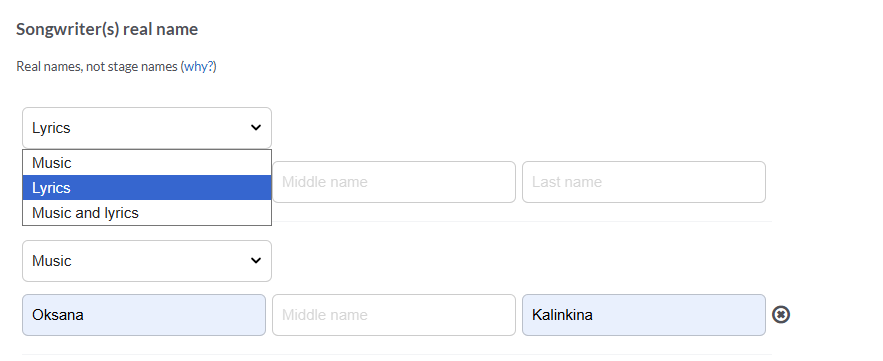
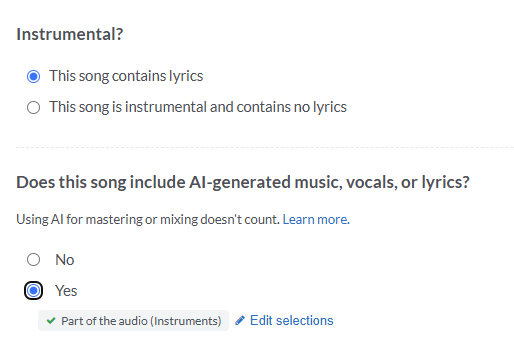
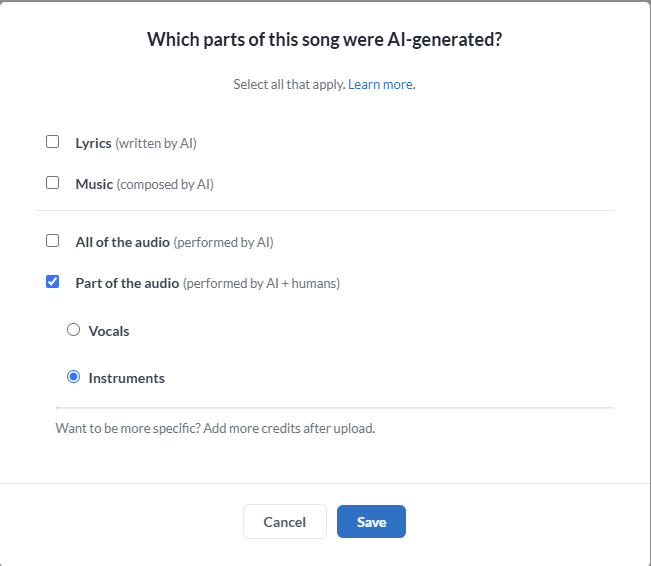
First, the form accepts separate music and lyrics credits. It then asks whether the song includes AI-generated music, vocals or lyrics. Answering yes allows the creator to select audio made partly by AI and partly by people, and then choose vocals or instruments. In the example shown, partial audio and instruments are selected; the boxes for AI-written lyrics and AI-composed music are not checked.
That is a distinction. But on this screen, it ends before the story of the work itself begins. It does not identify which instrument is affected, whether its entire part was generated, whether a human source performance was used, or whether the human's melodic and performance choices were preserved. Substantially different processes can sit within one category. A field should not make those differences inaccessible to the audience.[22]
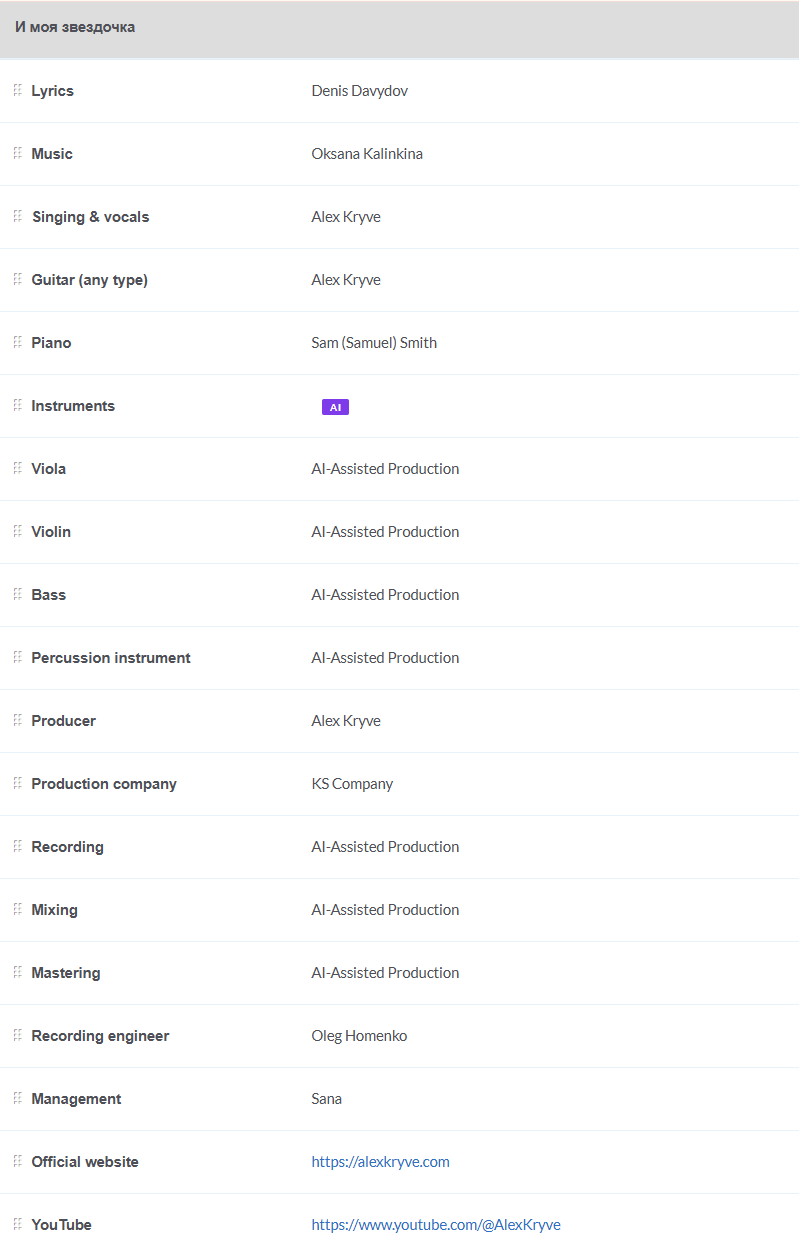
The credits list then contains a general entry: Instruments — AI. We must describe this accurately: the entry concerns instruments; it does not expressly attribute all lyrics, composition and vocals to AI. But the wording does not explain which instruments or actions are involved.
I add the information manually. The expanded credits for “И моя звёздочка” list Denis Davydov for lyrics; Oksana Kalinkina for music; Alex Kryve for vocals and guitar; Sam (Samuel) Smith for piano; Alex Kryve as producer; and Oleg Homenko as recording engineer. AI-Assisted Production is separately listed for several instruments and production stages. These are the contributions declared in my credits. The screenshot establishes that the declarations exist; it does not replace source recordings as evidence of the process.
DistroKid warns that services do not display every type of credit it delivers. Detailed information held by a distributor therefore does not guarantee that listeners will receive it on their platform.[23]
A separate public screenshot shows a short AI badge beside the title Before Hello. Within that crop, there is no explanation of which part of the work it concerns. The cropped image does not establish what further information may appear after a click or what the entire application supports. It is also a different song: I am not presenting the Before Hello image as proof of how the credits for “И моя звёздочка” were delivered. These are two examples of different stages that together raise the question of whether detail is preserved in public presentation.
The technology disclosure moves to the front. Comparable visibility for the people is not guaranteed. That is what requires explanation and examination from platforms.
Recording, processing and generation are different actions
The form explicitly says that AI use for mixing or mastering does not count for this question. DistroKid's official guidance also distinguishes generated elements from assistive processing. That is a reasonable distinction if it is applied consistently: technically processing an existing recording does not, by itself, mean creating the lyrics, melody or performance in place of a person.[24]
In my own workflow, I use an agent to create or adapt processing tools for a specific task. The fact that AI helped write a plug-in's code does not mean AI composed the music processed by that plug-in. I am describing my process, not claiming that every musician works this way.
But “processing” is not a universal answer either. If a model creates a new instrumental track or resynthesizes the sound from an uploaded performance, the final audio may contain generation. The origins of the new sound and the human contribution to the source composition or performance should then both be stated. The question turns on what the tool actually does to the material, not whether AI appears in its marketing.
The form should therefore distinguish at least the following information:
| Information to establish | Why it matters |
|---|---|
| Who wrote the lyrics and music | Authorship of the composition is not determined by how the sound recording was made. |
| Who played or sang the source material | Passing a recording into a model does not make the source performance's history irrelevant. |
| What the model generated or resynthesized | A new part, a new timbre and technical correction are different operations; the exact description depends on the tool. |
| Which human recordings remain audible in the final version | The source performer and the performer heard in the final recording are not always the same. |
| Who selected, edited and mixed the result | Production work should be visible, but crediting it does not itself establish authorship of every generated element. |
Roles, tracks and the origins of the material are more useful here than an arbitrary percentage of “artificiality.”
Additional mastering should not confuse the origins of a work
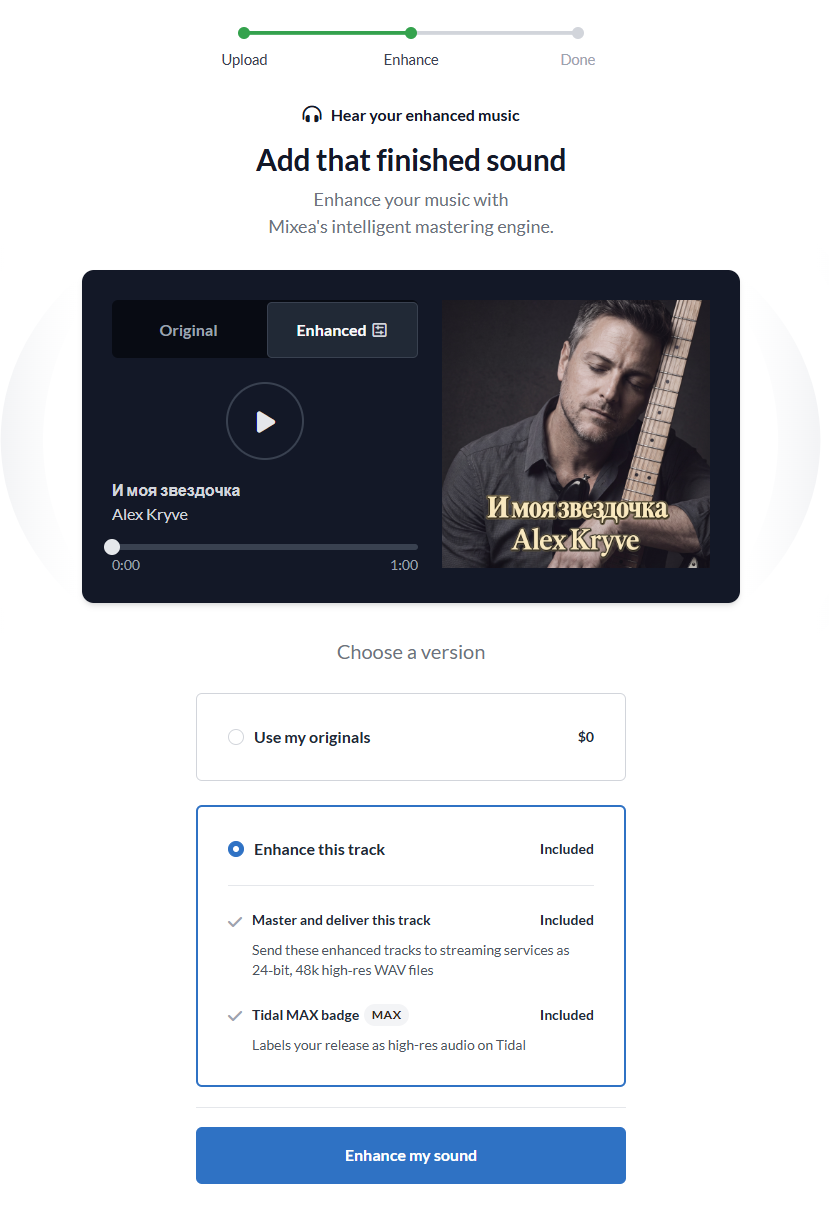
At the next stage, the interface offers to process the upload through Mixea. The screenshot shows an Original/Enhanced comparison and an option to use the original files. This is a separate mastering offer. It does not establish that all creators accept it, or that using the service is a condition of meeting streaming requirements.[25]
My preference for a particular treatment is part of my production and listening experience. It cannot be turned into a general fact that every track without that service must sound dull and quiet. Spotify describes loudness normalization as a playback adjustment; that is different from mastering and is not evidence of mandatory AI use.[26]
The precise question for the service remains: which operations does it classify as assistive processing, which as generation, and how does it explain the boundary to creators and audiences? If one technological operation can be used without a generative disclosure while another triggers one, listeners should understand what that particular disclosure means—not infer from it that people were absent from the entire process.
Technology does not undo what a person created
A song has several layers: lyrics, the musical composition, the performance, the particular sound recording and the visuals. Their origins may differ. Synthetic accompaniment does not automatically mean synthetic lyrics. A generated image does not turn a human-recorded vocal into an artificial one.
That distinction matters legally.
In its 2025 report, the U.S. Copyright Office confirmed that using AI as an assistive tool, or including generated material within a larger human-created work, does not by itself rule out copyright protection. Human expressive elements, creative modifications, selection and arrangement may be protected where the necessary conditions are met. Providing prompts alone is insufficient to establish authorship. This is the position of a U.S. authority; it cannot automatically be applied to every jurisdiction.[1]
The underlying logic matters: examine the contribution rather than diagnose the whole work by the presence of a technology.
If a person wrote a poem, using a generator for the accompaniment does not rewrite the history of those words. Equally, commissioning generation does not automatically make someone the author of every sound produced.
Recognizing human contributions requires precision in both directions.
The right to be recognized as an author is not a request for courtesy
International copyright law recognizes authors' moral rights. Article 6bis of the Berne Convention provides a right to claim authorship and to object to certain distortions of a work and other derogatory actions in relation to it that would prejudice the author's honor or reputation. The specific protection depends on national law.[2]
For someone working in Czechia, as I do, domestic law matters too. Section 11 of the Czech Copyright Act provides the right to claim authorship and to decide whether and how authorship is indicated when a work is published and used, where such attribution is customary.[3]
“Why is your name somewhere below not enough?” cannot therefore be dismissed as a frivolous question.
But the opposite claim would also be too simple: that any AI disclosure already infringes that right.
If a disclosure accurately identifies a generated part and the authors of the lyrics and composition are correctly credited, there may be no conflict. If human work is expressly described as entirely generated, author information is removed, or a verified error is not corrected, grounds for a complaint become more substantial.
This is an assessment of a possible legal situation, not a court finding about every existing label.
A label does not transfer copyright to a machine. It can do something else: create a mistaken impression about who did the creative work.
That is what needs examining.
People are protected by more than copyright
The relationship between people and their creative work is also recognized in human-rights instruments.
Article 27(2) of the Universal Declaration of Human Rights recognizes protection of the moral and material interests arising from works a person has authored. The Declaration is a foundational international instrument, but it is not itself a treaty or a ready-made basis for claiming compensation from a platform.[14]
Article 15(1)(c) of the International Covenant on Economic, Social and Cultural Rights recognizes a corresponding right in a treaty. In General Comment No. 17, particularly paragraphs 12–14 and 39(b), the UN Committee on Economic, Social and Cultural Rights connects authors' moral interests with recognition as creators and protection from certain actions prejudicial to their honor or reputation. The comment interprets the treaty; it is not a judicial ruling on AI labeling.[15]
In Czechia, Articles 10(1), 15(2) and 34(1) of the Charter of Fundamental Rights and Freedoms are particularly relevant: protection of dignity, honor, good reputation and one's name; freedom of artistic creation; and statutory protection of the results of creative intellectual activity. These provisions establish a foundation for protecting people. Specific claims against a private platform still require applicable legal grounds and facts.[16]
At EU level, Article 13 of the Charter of Fundamental Rights protects freedom of the arts, and Article 17(2) protects intellectual property. Article 51 limits the Charter's scope: it addresses EU institutions and Member States when implementing EU law. It cannot therefore be presented as a universal, standalone claim against any private service.[17]
My conclusion from these provisions is more limited and precise than “every AI badge violates human rights.” Human authorship, names and reputation are protected interests. When designing transparency around technology, they cannot be treated as insignificant merely because information about people survives somewhere in additional fields.
“It is all in the description” does not end the discussion
An AI badge and detailed credits perform different functions. One accompanies the first encounter with a work. The other requires the listener to take an additional step.
Even if both messages are formally accurate, they may carry different perceptual weight. The badge is visible; the human contribution has to be found. My question concerns precisely that unequal visibility.
The comments show me that some listeners extend the idea of artificial origin to the entire song. I cannot claim they would necessarily have judged it differently without a badge. But I have grounds to ask whether the presentation encourages a conclusion the detailed production information does not support.
Framing is a useful concept here: presentation establishes a context within which a work is perceived. It is an explanatory concept, not an independent legal cause of action. Our hypothesis is that, for some audiences, the technology indicator becomes the principal explanation of the entire work's origins. Its scale and causal relationship with a particular badge require research.
It is therefore insufficient to establish that credits are available somewhere. We must also examine what the first screen communicates. The distinction between partial and full generation should be visible where the technology disclosure appears. That is my request for interface design, not a quotation from existing legislation.
EU consumer-protection law already contains a significant principle: a commercial practice can mislead through its overall presentation even if individual pieces of information are factually correct. Article 6 of Directive 2005/29/EC establishes this. Applying it requires the relevant conditions, including a commercial practice and an actual or likely effect on a consumer's transactional decision. It does not automatically make every disputed badge unlawful.[4]
The principle nevertheless deserves attention: the accuracy of a message cannot be assessed solely by whether a qualification can be found several clicks later.
Potentially misleading audiences about a work's origins and human contributions describes the problem more accurately than saying a label itself “cancels copyright.”
Reputation and non-material harm
When a person is falsely represented as not having done work they actually performed, the dispute may extend beyond attribution.
The Czech Civil Code protects dignity, honor and a person's standing. Sections 81–82 provide protection against unlawful interference and for removal of its consequences.[5]
Where copyright infringement is established, Section 40 of the Copyright Act provides remedies including a declaration of authorship, removal of the consequences of infringement, and satisfaction for non-material harm—including an apology and, where another form is insufficient, monetary satisfaction.[6]
This does not mean that using AI is itself discreditable. I disagree with that attitude toward the technology.
The problem arises when a person is falsely denied recognition for work they performed, portrayed as a fraud, or otherwise subjected to unlawful interference with their rights.
A specific claim will require evidence: the label, the actual contribution, the context of publication, the nature of the interference and, depending on the remedy sought, harm and causation. Hurt feelings are understandable without a lawsuit. Compensation requires a legal basis.
What the law and platforms actually require
“New rules” cannot explain every oversimplification.
Article 50 of the EU AI Act distinguishes providers' obligations to make synthetic outputs machine-readable and detectable from deployers' obligations to disclose certain content, including deepfakes. Paragraph 2 includes an exception for assistive standard editing and certain non-substantial changes. For evidently artistic works, paragraph 4 provides for an appropriate form of disclosure that does not hamper the display or enjoyment of the work. This is not a general exemption for art from transparency.[7]
According to European Commission guidance, Article 50 applies from 2 August 2026; certain systems already on the market have a limited transition period for the technical marking obligation.[8]
This does not establish a requirement to call an entire work exclusively an AI product whenever any technology has been used.
In its announcement of 27 May 2026, YouTube expressly described more prominent labels for certain AI content: below the player for long-form video and over Shorts. The service says disclosure itself does not affect recommendations or monetization eligibility. That describes platform policy; it does not answer the separate question of how an indicator affects viewers' choices.[21]
Platforms also differ.
YouTube's general guidance distinguishes meaningful generative changes from minor corrections, including audio repair. For music partners, it supports fully generated, partly generated and no-generative-AI categories. Automated AI mastering that adjusts equalization, compression and balance is an example of the last category. Generating specific instrumental layers alongside live performance is an example of partial use.[9][10]
Spotify describes AI credits for individual roles rather than an entire track. Where a role contains both human and generated contributions, it asks for them to be credited separately. The feature is in beta and depends on distributor support.[11]
When Deezer announced a forthcoming AI-music exclusion toggle in October 2026, it specified fully generated tracks and said limited assistive elements within a broader human creative process were treated differently. That is the service's account of its policy, not an independent evaluation of its detector's accuracy.[12]
These policy distinctions matter. They do not, however, resolve how the result is presented to listeners. Detailed metadata categories and a clear first-screen explanation are different tasks.
We therefore need to examine the actual interface: does the visible disclosure preserve distinctions the platform already recognizes in its documentation, or does the listener receive a generic AI indicator, with all substantial qualifications available only after additional actions?
The pastry did not change. The label did.
Imagine a restaurant. A customer eats a pastry, loves it and asks to thank the chef. The chef comes out and hears how wonderful the dessert was. Then the chef says, “Artificial intelligence suggested the recipe.”
The customer suddenly grimaces: “Oh, I see. Your pastry was bad.”
What changed? The taste? The ingredients? The chef's hands? A moment ago, the customer liked what they had tasted. Information about the tool made them revise their own impression.
This is a hypothetical illustration, not an account of a real experiment. But the influence of attributed authorship is being studied. A 2025 visual-art study, consisting of two preregistered experiments with 125 participants in total, associated AI labeling with lower evaluations of comparable works. The study does not establish the effect of a specific YouTube badge or measure music audiences. It provides grounds to investigate the influence of presentation rather than assume neutrality.[18]
Audiences have a right to consider how work was made. That requires an accurate account of its origins. My objection concerns both the timing and the substance of the message: why does a technology indicator characterize the whole work first, while the person appears only in the details?
When transparency encourages concealment
There is another risk that concerns me even more. If openly admitting to one generative tool becomes a reputational penalty for the entire work, the creator has an incentive not to disclose it.
I do not know how many creators actually do this and do not claim it is proven majority behavior. I am asking about the incentive structure: how safe is honesty for recognition of human work?
An imbalance may emerge: a creator who discloses the process is labeled because of their own information. A creator who says nothing remains unlabeled if detection fails. The technological fact is the same; the public situation differs. In such a system, the absence of a label does not establish the absence of AI.
This is an argument for understandable disclosure. I am not proposing concealed origins, removed markers or evasion. I want a system in which preserving information is more worthwhile than hiding it.
Why a detector cannot replace the history of creation
A visible logo, an embedded watermark, signed file-history information and a probabilistic detector must not be conflated. They are different mechanisms with different capabilities and vulnerabilities.
One historical example is instructive: OpenAI discontinued its text classifier in July 2023 because of low accuracy and separately warned of false positives. This is a fact about one older text tool, not a description of all current detectors.[19]
Google describes SynthID text-watermark detection as probabilistic and notes that extensive rewriting or translation can reduce confidence. NIST examines provenance, marking and detection as distinct technical approaches with their own limitations.[20]
This does not establish that any agent can reliably bypass every check or that every marker can be removed. Such promises require independent testing. Nor is it correct to describe every AI tool as continuously training while we speak: system updates and training a particular model are different processes.
The more important point is this: even correct detection of generation does not fully answer questions of human authorship. A signal in an instrumental track does not establish the origins of the poem. The absence of a signal does not confirm the absence of generation. Establishing individual elements' origins requires information about the process and contributors.
Transparency that depends only on searching for traces, while discouraging voluntary disclosure, risks undermining its own purpose. That is a hypothesis about policy consequences; it should be tested with evidence rather than replaced with a slogan.
Why a person is responsible for the result
There is a legally sound part to the central objection: authorship and responsibility are different questions.
Someone may not have authored a photograph but may be liable for publishing it unlawfully. An organization can distribute material without being its author. Responsibility for uploading a generated result does not, by itself, establish the uploader's authorship.
YouTube's terms expressly place responsibility for supplied content on the person or entity providing it, while also stating that users retain the rights they own.[13]
This does not mean every participant in a project is responsible for everything. The grounds and extent of responsibility must be established separately, considering the applicable law, role and circumstances.
I am not suggesting that people should escape responsibility by saying “AI did it.” That would leave those harmed without protection.
I am asking people to stop using the distinction between authorship and responsibility to justify crude descriptions of human work.
If someone only commissioned generation, say so. If they wrote the lyrics, identify the lyricist. If they sang, identify the singer. If instruments were generated, identify those instruments.
Detail must not become necessary only when it serves a complaint.
Transparency should work in both directions
I want a system in which, at the first encounter with a work, people understand whether generation concerns the whole work or specific elements. A short explanation beside the indicator might say, “AI: instrumental accompaniment. Lyrics: Denis Davydov. Vocals: Alex Kryve,” if that accurately describes the particular recording.
Detailed credits remain necessary. But they should expand on an accurate first message rather than repair an impression created by an overly broad indicator.
No invented percentages. What does “30 percent artificial” mean when a poet wrote the lyrics, a composer wrote the melody, a singer recorded the voice and the accompaniment was generated? Percentages of duration, cost, files or creative significance?
Roles tell us more.
Role information also helps those who want to continue working with the material: it can establish the origins of elements and identify contributors and rights holders. Neither credits nor an AI disclosure grants permission for reuse. Rights and license terms must be checked separately.
Even an entirely generated recording may use lyrics written by a person. Equally, having a human lyricist does not turn a generated performance into a live one. Both facts can be stated together.
There must also be a clear way to correct inaccurate labels: submit source files, recordings, project versions and contributor information, and receive a substantive response.
This is a proposal for fair platform design, not a claim that the law already guarantees every such interface feature.
Listeners are entitled to know about generative technologies. Authors are entitled to expect accurate attribution of their work. These interests do not require choosing one and hiding the other.
I am prepared to take responsibility for my decisions. I identify where I used technology and who participated in the work.
I want the same precision when it comes to recognizing that work.
Transparency cannot be measured only by the number of fields completed. It must also be assessed by the understanding received by the person for whom those disclosures exist.
If the technology is immediately visible, the human contribution should not be a discovery reserved for the few who decide to read the documentation.
If a person is real enough to bear responsibility, their actual creative contribution should be visible enough to receive recognition.
Sources and limits of the conclusions
Checked on 29–30 October 2026. This article primarily concerns Czechia and the EU; the U.S. position is identified separately for comparison. It does not claim a court has held generic AI badges unlawful as a category. The legality of a particular disclosure depends on its wording, context, verified contributions and applicable law.
Legal reference map
| Protected interest | Provision | Relevance to this discussion |
|---|---|---|
| Recognition of authorship | Berne Convention, Article 6bis; Czech Act No. 121/2000, Section 11(2) | Examine whether a specific disclosure denies verified human authorship. |
| Name, dignity, honor and reputation | Czech Charter, Article 10(1); Civil Code, Sections 81–82 | Potential protection against unlawful interference; association with AI is not itself characterized as an insult. |
| Non-material harm from copyright infringement | Act No. 121/2000, Section 40(1)(e) | Apology and, under the relevant conditions, monetary satisfaction may be available; a badge does not automatically create an entitlement. |
| Authors' moral and material interests as human rights | ICESCR, Article 15(1)(c); General Comment No. 17 | International foundation for states' obligations to protect people and their relationship with their work. |
| Misleading presentation in commercial practices | Directive 2005/29/EC, Article 6 | Overall presentation matters; applicability and an actual or likely effect on a transactional decision must be established. |
| Transparency about generative technology | AI Act, Article 50 | Duties differ by actor and content; this is not a provision extinguishing human authorship. |
What to document for a specific complaint: the exact indicator and its position on a particular platform and device; explanations visible immediately and after interaction; actual credits; source recordings and versions; dated comments denying human contributions; correction requests and responses. Comments may establish that a particular perception exists, but alone do not establish its prevalence, cause or the extent of harm.
Screenshots: what the interface shows
Original screenshots supplied by the author. Open an image to inspect it at full size. Dates in the source filenames were not independently verified. The final crop concerns a different release.

Source notes and references
- [1]
U.S. Copyright Office: Part 2 findings, 29 January 2025—copyrightability of human contributions and the limits of prompts.
- [2]
Berne Convention, Article 6bis—WIPO—authors' moral rights.
- [3]
Czech Act No. 121/2000—e-Sbírka; Ministry of Culture English translation—Sections 2, 5 and 11. The translation is unofficial; the Czech text takes precedence.
- [4]
Directive 2005/29/EC, Article 6—EUR-Lex—misleading overall presentation in commercial practices.
- [5]
Czech Civil Code, Act No. 89/2012—e-Sbírka—Sections 81–82, protection of personality.
- [6]
Section 40, Act No. 121/2000—government portal MZe—remedies and non-material harm.
- [7]
AI Act, Article 50—European Commission AI Act Service Desk—types of obligation and exceptions.
- [8]
European Commission: Article 50 FAQ—application dates and transition period.
- [9]
YouTube: Disclosing use of GenAI content—general disclosure rules.
- [10]
YouTube: Disclose Gen AI usage for music content—partner categories, partial generation and mastering. Metadata categories do not establish that every distinction is always shown in the audience interface.
- [11]
Spotify: AI credits—individual role disclosures and beta limitations.
- [12]
Deezer: announcement of 13 October 2026—stated policy for fully generated music; the toggle was announced for introduction before the end of 2026.
- [13]
YouTube: terms for Czechia—responsibility for submitted content and retention of users' existing rights.
- [14]
Universal Declaration of Human Rights—UN, Article 27(2)—authors' moral and material interests. A declaration, not itself a treaty.
- [15]
ICESCR, Article 15(1)(c), official UN treaty collection; UN Committee General Comment No. 17, paragraphs 12–14 and 39(b). The Covenant creates obligations for states parties, including protection against third-party interference. Particular remedies depend on the relevant legal system. The comment is the committee's interpretation, not separate legislation.
- [16]
Czech Charter of Fundamental Rights and Freedoms—Chamber of Deputies, Articles 10(1), 15(2) and 34(1). Constitutional foundations for protecting names, dignity, reputation and creative work, implemented through legislation. Citizenship is not itself a condition for these protections.
- [17]
EU Charter of Fundamental Rights—EUR-Lex, Articles 13, 17(2) and 51; official explanation of scope—European e-Justice. Not every private dispute automatically falls within the Charter's scope.
- [18]
Neural correlates of evaluative bias against artificial intelligence-labeled versus human-labeled artworks, Social Cognitive and Affective Neuroscience, 2025. The study concerns images and attributed authorship; music and particular interfaces require separate testing.
- [19]
OpenAI: New AI classifier for indicating AI-written text. The page records discontinuation on 20 July 2023 because of low accuracy. A historical example, not an evaluation of current audio systems.
- [20]
Google: SynthID Text—detection and limitations; NIST AI 100-4, Reducing Risks Posed by Synthetic Content. Text, audio and image detection are not interchangeable; these materials do not establish universal evasion guarantees.
- [21]
YouTube: Improving AI labels for viewers and creators, 27 May 2026. Describes more prominent indicators, automated detection and recommendation/monetization policy. Presentation depends on content type and surface.
- [22]
Creator-provided screenshots: separate music and lyrics attribution; initial AI question; partial audio → instruments. DistroKid: How to Fill Out AI Credits. A date in a filename is not independently verified evidence of the interface's capture date.
- [23]
DistroKid: Why Aren't My Credits Showing in Streaming Services?; adding credits and liner notes. Expanded credits for “И моя звёздочка”; separate Before Hello public crop with AI badge. The crop does not identify the platform or show interaction behavior; it should be interpreted within these limits.
- [24]
DistroKid: What Are AI Credits?. Assistive mixing, mastering and certain workflows are excluded from generative-credit requirements. This distributor rule does not mean all audio processing is AI, or all audio-to-audio processes are exempt from generation disclosures.
- [25]
Mixea offer screenshot; DistroKid: post-upload mastering offer and option to decline; How Do I Use Mixea?. An offer does not establish necessity, nor the quality of any particular comparison without loudness-matched listening.
- [26]
Spotify: Loudness normalization. Loudness normalization, mastering, encoding and generative AI are different processes. Digital processing does not establish AI use.