I’d never given myself as much credit as I did when people started labelling me “artificial intelligence.”
Let me explain where that thought came from.
Yesterday, I was uploading another single through my distributor and found yet more changes to the upload form.
First came the question: were artificial intelligence tools used to make the music? Two options: yes or no. Later, the form became a little more detailed, allowing you to specify which part of the work involved AI. That is much closer to how making music actually works.
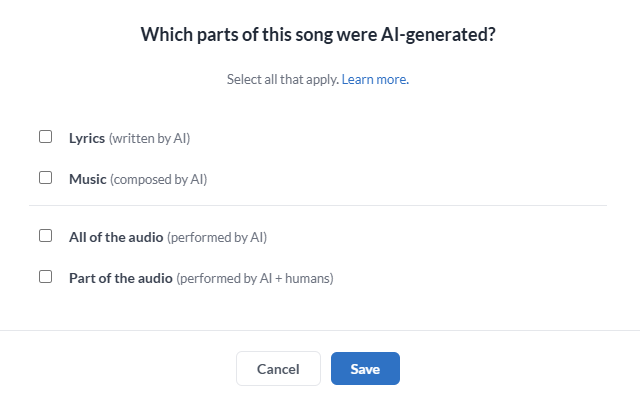
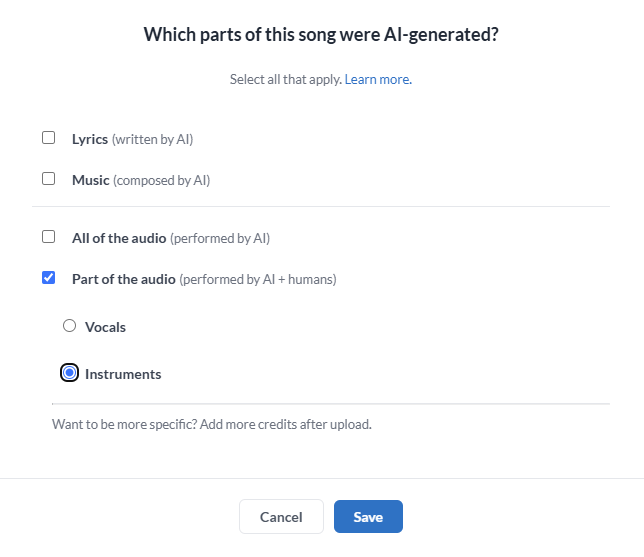
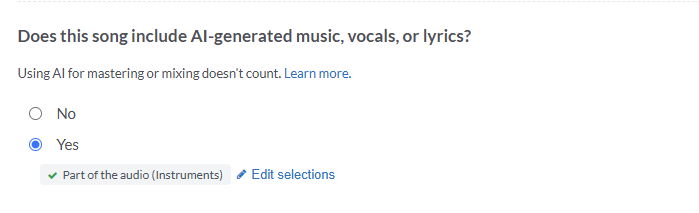
Now a similar question has appeared when you upload the cover art.
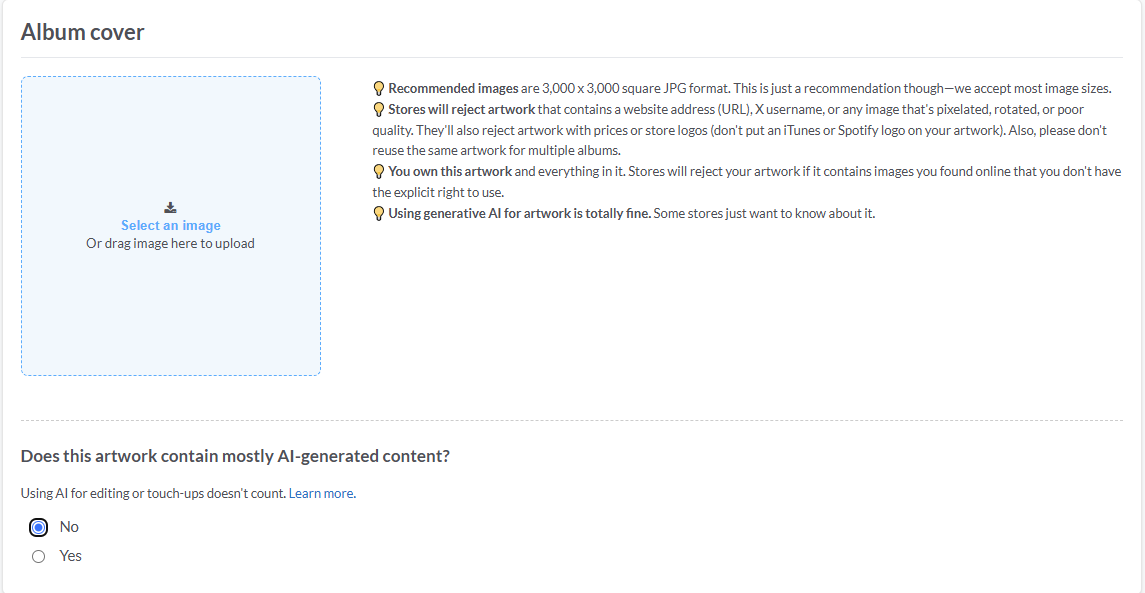
And there I am, looking at all this and thinking: I’ll tick the box. I have nothing to hide. But what exactly will the listener learn once I have?
And where do I disappear behind that checkbox?
I’m a singer and guitarist. I sing and play acoustic and electric guitar. I don’t play the violin. Or the cello. And, honestly, I’m not about to learn every instrument for the sake of a few projects.
Yes, I can find my way around a bass. But I understand perfectly well the distance between “I can play a little” and a good bass part for a recording.
There are musicians I’ve worked with for many years. But everyone has a life of their own. Our bass player is now in another country, with family circumstances to consider. We can’t keep getting together to record. We worked together on tour, but making studio recordings at a distance is another story.
Sam lives in New York. When I’m there for work, we record material that may come in useful later. But he isn’t sitting in the next room, where I can say at any moment, “Sam, shall we try something different here?”
Many of you already know about Zhenya, our drummer. He is no longer with us. A model trained on his playing remains part of the work. And to me, those words stand for a particular person, his way of playing and our years of working together.
A great deal of work went into the strings too. Violinist Yulia Lazarenko helped us gather material and develop the sound of the string section. There is a model based on her violin recordings. We also learned to do certain things with my acoustic guitar: transform its sound, look for a violin-like phrasing, try other timbres.
Behind all this, then, are people, source recordings, decisions, experiments and revisions. There is work that a single checkbox cannot possibly describe.
So yes, I use artificial intelligence tools. And I’m quite comfortable saying so.
You hear my voice. You hear my guitar. Additional parts may be made in different ways: with musicians, from material prepared earlier, using software instruments and AI. Each recording has its own combination.
When I fill in the release information, I honestly state what I’ve used. And in the detailed credits, I try to list the people, instruments and each person’s work.
My sister and I work as a team too. She handles the administration, legal matters and rights. Sometimes she contributes creatively as well: helping with a lyric, refining it, making corrections. She is also a guitarist and singer, although she isn’t keen on singing in public. You will, however, be able to hear her guitar in some of my future work.
These are all specific roles and specific people.
But then I open a release — on a YouTube Topic channel, for example — and see a label mentioning artificial intelligence. What I don’t find in plain sight is a detailed explanation of who sang, who played and where the technology was used.
I can’t tell you at what stage each piece of that information gets lost or becomes less visible. What the distributor sends, what a particular platform displays, what stays tucked away in extra sections. I see the result through a listener’s eyes: the label is there, but you still have to go looking for the story of the work.
And people reach a conclusion faster than they open the credits.
I once received a comment along these lines: “So none of this is him. It’s all artificial intelligence. Who is he anyway?”
The funniest part was that it appeared under a romance set to a poem written in 1834.
What do you say to that? I sent a link to an archive where the reader could find the text and learn about its author. It does help to get acquainted with nineteenth-century poetry before attributing it to artificial intelligence.
But the situation itself is telling. Someone sees a label and, in one move, removes everyone from the work. The poet, the composer, the performer, the musicians. Its whole history.
It says artificial intelligence, doesn’t it? No need to look any further.
Now, back to the cover art.
The form I was filling in had an explanation about retouching and filters: that kind of processing did not require the label. More substantial AI use was to be disclosed. There was also an explanation that using AI was not itself prohibited and that some stores wanted the information.
Fine. I’ll disclose it.
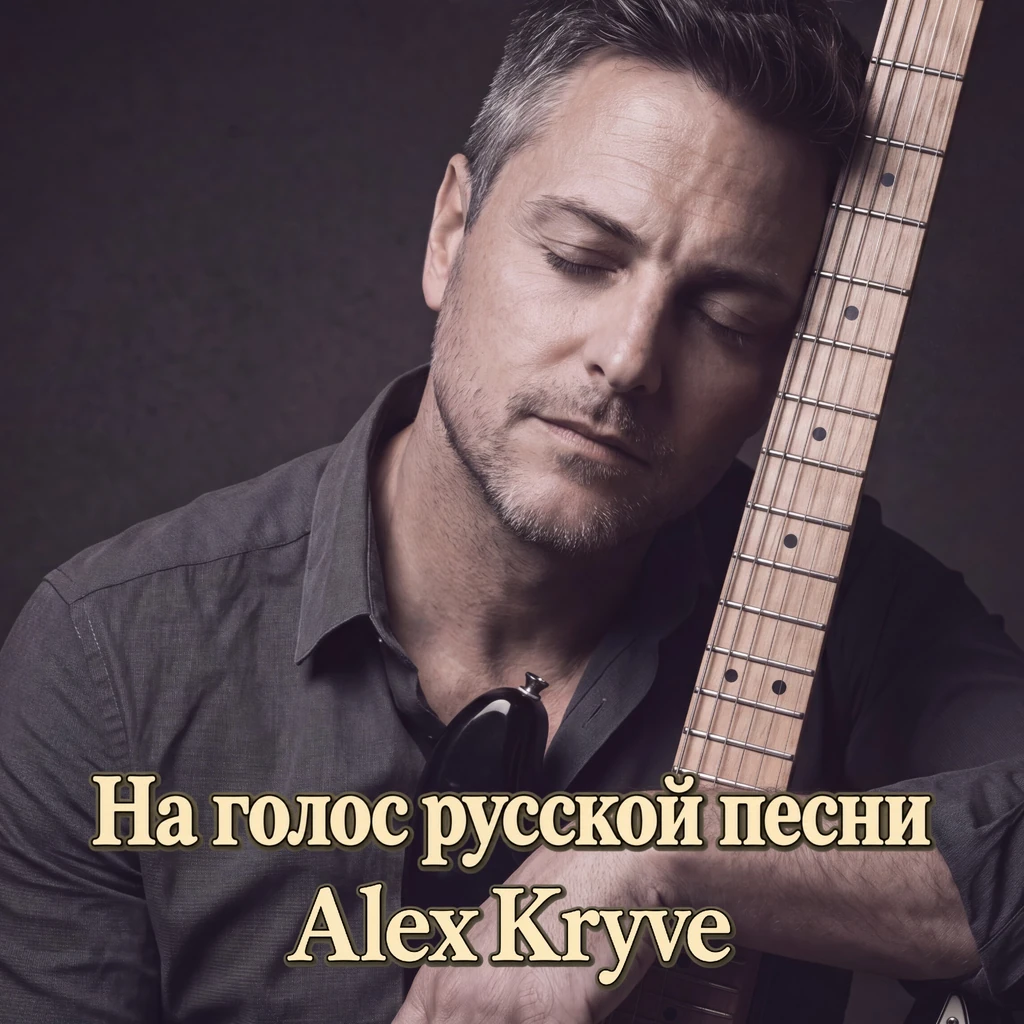
But picture an ordinary working situation. There is a photograph. There is a photographer. There is someone doing the design. We work out the artwork, then use AI for the lettering: give it the cover, provide the text and ask it to find a colour, typeface and position that make everything look good and read clearly.
For me, that is part of the working process. I entrust a particular task to a tool, look at the result, choose and ask for revisions.
The lettering is done. The box is ticked.
Whose face is on the cover now?
Have I stopped being the person pictured there? Has the photographer stopped being the photographer? Has the person who put the composition together stopped contributing to the work?
I understand that the label itself does not have to mean any of that. But I wonder what a viewer who knows none of the details will read into it. Will they see information about one of the tools — or conclude that they are looking at a completely invented character?
You know I love experimenting. Yesterday, I tried another little experiment of my own.
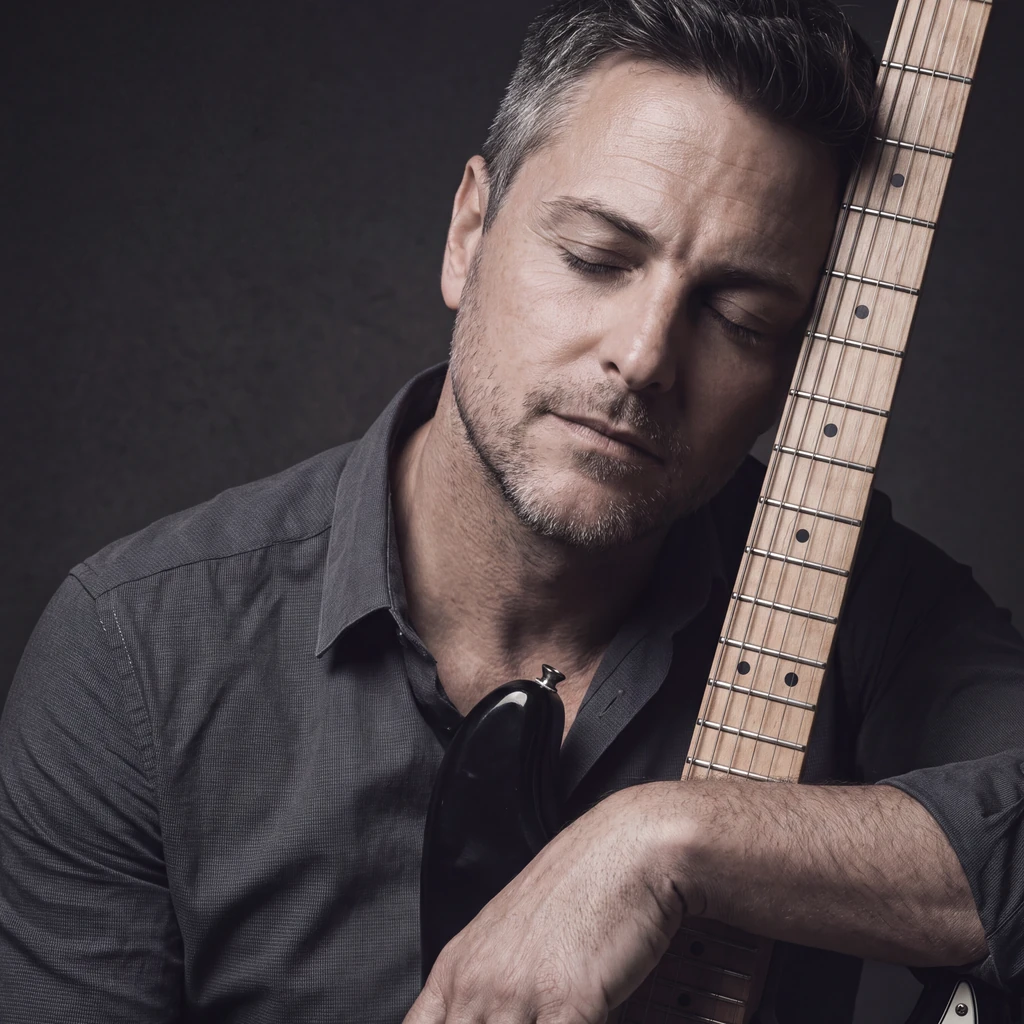
I took a photograph of myself and asked ChatGPT to create an image based on it. I specifically wanted a generated portrait. Then I opened another AI service which, I assumed, knew nothing about the context of my work, uploaded the picture and asked who was in it.
It replied with my name — Alex Kryve — and information about me.
Honestly? I nearly fell off my chair.
I started asking: where did you get that? What were the clues? An explanation along the lines of “a man of a certain age, short hair, some grey” did not satisfy me at all. Go outside — there are plenty of men like that. Why did you name me in particular?
I didn’t get a convincing explanation. And that answer alone does not prove that the system recognised me by my face. I can’t say with confidence what clues or information it used, or how much coincidence played a part. One experiment of mine is not enough to establish that.
But it made quite an impression. I even joked, “I’m beginning to feel as though you’re spying on me.”
And then I thought about that label again. An image can be generated while the person whose likeness it uses is very much alive. How do you explain that to someone used to dividing everything into just “real” and “artificial”?
Meanwhile, I have no intention of turning my life into an endless exercise in proving that I exist.
Film every step I take? Walk around with a camera so nobody doubts that I really did walk the dog today? Show my passport? My tax number?
I make things. I want to write, sing, play and work on the next song. Somehow, my schedule does not include continually establishing whether I exist.
And you can show as much as you like to someone who has already made up their mind from one label. They’ll find a reason to doubt the next piece of evidence too.
Personally, I’m far more interested in finding out how the work was made.
If you like something and simply want to listen, listen. You can enjoy a song without investigating every note.
And if you’re curious about how it works, explore. Open the credits. See who took part. Ask the creator a specific question: what did you use here, how did you get that sound, how was that part made?
I do that myself. We talk with colleagues, meet at conferences, have calls and discuss tools. We ask each other, “How did you do that?” Sometimes that question is the beginning of a whole new piece of work.
That interests me. It’s a conversation in which you can learn something.
And there is another side to this story that I love.
Sometimes you write to me in verse in the comments. Or leave a poetic line that I immediately want to pick up. I reply, and an exchange begins. Line by line. Perhaps a word hasn’t arrived yet, perhaps there’s a “ta-da-da” in its place for now, but the thought is already singing and you want to keep it going.
One listener admitted that she used a program to help her. So what? Did that make talking to her any less enjoyable? Not at all. She wanted to join the conversation, found a way to express herself, and I was happy to reply.
Sometimes I can spend half the day speaking in rhyme myself. Something just switches on in my head, and off it goes. But there isn’t always someone nearby who enjoys that too.
Then I open ChatGPT and start a conversation in verse. It replies, I carry on. Then I stop it: “Wait, that’s too simplistic. The rhythm has gone astray. We started in one style and you’ve jumped into another. Let’s try again.”
And I get enormous pleasure from it. From the dialogue itself, from searching for a line, from being able to hear a response and immediately think of the next one.
What is an “artificial intelligence” label supposed to explain to me at that moment? I already know what tool I’m talking to. The pleasure I get from that work is quite real.
And yet that label unexpectedly gave me courage. To understand why, you need a little of the backstory.
I used to write someone a poem on a napkin at the table. Wish my mother a happy birthday, give a friend a few lines. It was something personal, close to home, for people I knew.
But of course, it went far beyond napkins. My sister and I have written so many poems and songs that I probably couldn’t count them now. Yet we never thought we ought to sell them. We didn’t bother with registration or build some separate enterprise around it. Someone asked, and we happily handed a song over.
Later, I would come across our songs with completely different names under “lyrics by” and “music by.” Sometimes almost unchanged. I knew some of those people personally. Other names meant nothing to me at all. I even kept a whole collection of those recordings: I would find them, recognise our words and melody, and save them.
Let me say this straight away: I have no intention of going back over old stories or disputing anything. What happened has happened. I’m telling you this now because I want to explain how I felt about my own authorship at the time.
You know, I even felt embarrassed when someone named me as the writer. Honestly. It made me uncomfortable. And sometimes I could feel happy seeing another name beside my song: the song had a life, someone was performing it. After all, I knew where it had come from.
That may be difficult to understand from the outside. I’ve talked about it with other people. Some mentioned impostor syndrome. I don’t know how well that describes me. I only know that for a long time, I found it hard to regard that part of myself as anything special.
There are people with degrees in literature or philology. They have deliberately studied how to work with words. I don’t have that education. But it’s as though there’s a switch in my head. My eye catches something, I hear a phrase, someone says something in reply — click, and off I go.
Sometimes at the right moment. Sometimes, frankly, not so much.
Once it switched on while I was still going through checks at the airport. There was a nine-hour flight ahead, and I was already thinking: will this really keep going until we land? I think just about everyone I managed to talk to on that flight got a poem of their own.
It felt natural to me. It simply happened inside. I wasn’t thinking: now I’m engaged in some special act of creativity. A line just arrived. Then another. And another.
And I was shy about it. Because there are Pushkin, Blok and Fet. There are writers I admire. I can try writing in a style that feels close to me, play with an intonation, but put myself on the same shelf as them? Oh no. Who am I to do that?
Then along comes that label: “artificial intelligence.”
And I think: hold on. In my mind, behind that tool is a vast world of literature, with countless writers, styles and voices. And you’re confidently attributing my line — the one that has just come into my head of its own accord — to that?
Wow. Well, I never. I’d never given myself that much credit.
That’s what I mean. In my little joke, one badge seems to have placed me somewhere very high indeed. Of course I’m being ironic. But I really did gain some courage.
I became more comfortable posting poems, replying in public and sharing things that used to stay within a small circle. So a label that was apparently supposed to embarrass me unexpectedly helped me feel less shy about claiming my own authorship.
It still hasn’t helped me understand the habit of judging an entire work by one little badge.
I’m happy to talk honestly about my tools. Tick the boxes. Fill in the credits. Name the people I work with. I want that honesty to help listeners understand a piece and see each person’s contribution.
Yet all too often, something strange happens: the more you explain about one tool, the easier it becomes for everything else to disappear behind its name.
So my wish for these labels is very simple: let them make it clear what was done with AI and what people did. Let the details be available right where the listener already is.
And to those listening, a simple request: before confidently writing “none of this is him,” give yourself a minute to find out.
I’ll tick the box.
Just don’t lose sight of me behind it.
Alex