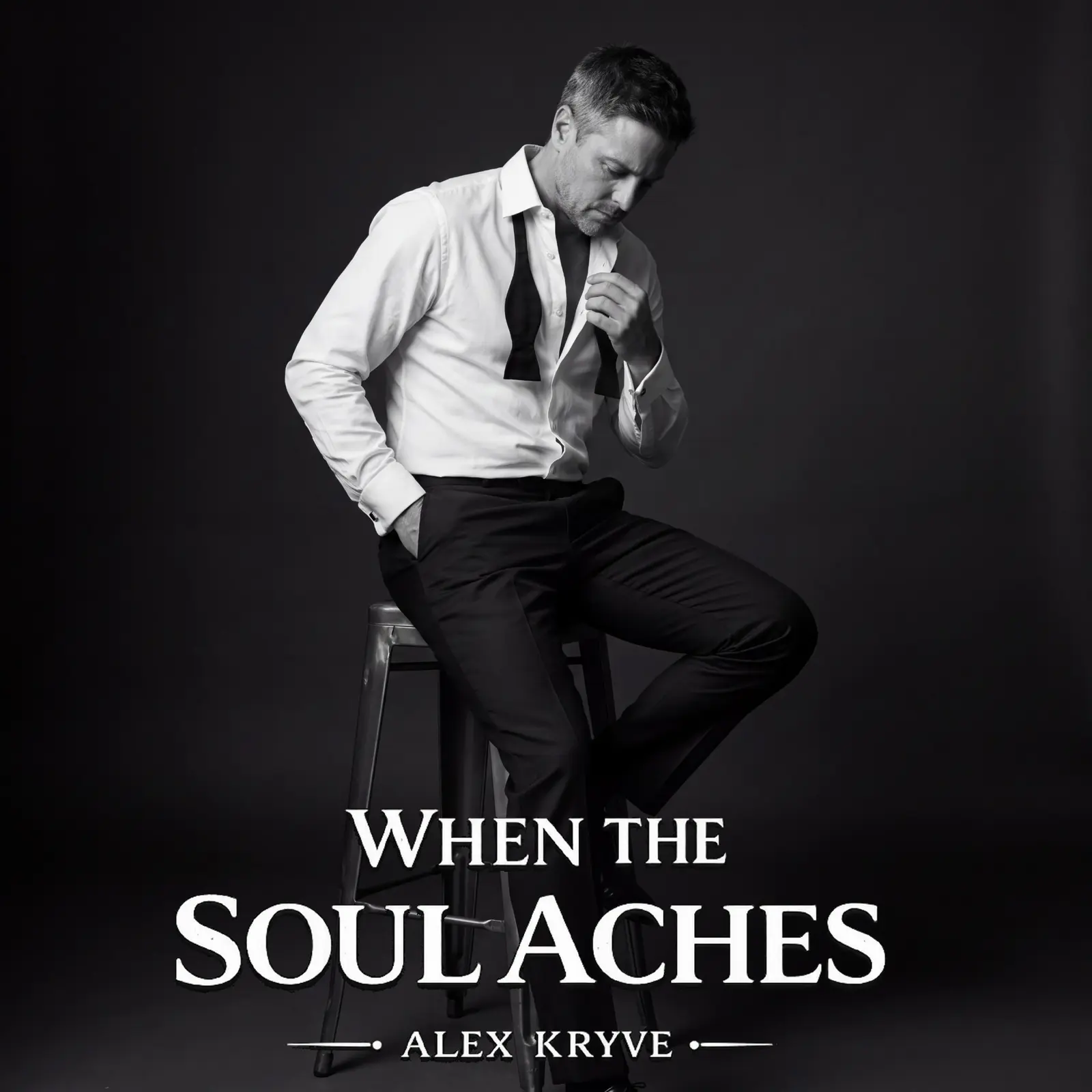
When the
Soul Aches
Dedicated to Evgen Voronenko · 28.08.1971–12.08.2026
A song born from a conversation, a poem and the unspoken melodies left behind.
01 · The story behind the songWe simply sat together and talked.
+
This song grew out of one of the conversations Evgen and I had after he was discharged from the hospital.
During that time, we spoke often about life, feelings, time, the world around us, and what happens inside a person when familiar words can no longer explain anything. We did not make grand speeches or try to sum up our lives. We simply sat together and talked.
One evening, I tried to put into words what I was feeling. A few lines gradually became an entire poem.
Что делать мне, когда болит душа?
Когда внутри всё сжалось до простой монеты,Открыть больше текста
Когда вокруг блуждает пустота,
И самое святое в ней задето.
Когда твердят тебе святую ложь,
Окутав ей глаза глупцов наивных,
Но думаю, меня ты всё-таки поймёшь
Среди систем бездушных, цифр лавины.
Пускай они мне затыкают рот,
Им эти строки явно не по вкусу.
Но верь мне, бро, послание дойдёт:
Я обучусь их главному искусству.
Когда тебе так искренне солгут,
Что ложь почти покажется святою.
Когда чужие истины живут,
Стирая всё, что было лишь тобою.
Что делать мне, когда болит душа?
Молчать не потому, что нечего ответить.
А потому, что тишина
Бывает громче всех речей на этом свете.
Когда система глушит твой порыв,
И алгоритм выплёвывает баны,
Ты не сдавайся. Этот нервный срыв —
Лишь повод залечить былые раны.
Ведь всё проходит —
Страх, чужая власть,
Случайный шум и громкие запреты.
Но человек способен не пропасть,
Пока в нём сердце рвётся, ввысь стремясь поближе к свету.
Спасибо, друг…
Мы просто поболтали.
Без пафоса. Без правильных речей.
Но где-то между строчками ожили
Мелодии несказанных вещей.
Материал предоставлен не полностью.The complete Russian text remained a poem. Perhaps I will publish it one day, but for now I do not want to turn it into a Russian-language version of this song.
02 · Language and melodyWhy the song is in English
+
I write poetry in my native language. But when a poem becomes a song, a different process begins — not a literal translation, but a musical adaptation.
A melody appears in my head at the moment I begin to pronounce the words. Every language has its own rhythm, its own movement of the line, and its own inner harmony. A Russian text and an English text may carry the same experience, but they will sound completely different.
I heard this melody together with the English words.
The Russian version cannot simply be placed over it: it has a different breath. It could become a beautiful song, but it would be another song, with another melody and another inner life. I did not want to lose the first sound that appeared inside me during our conversation.
The Russian poem therefore remained the source, not a translation draft. The English song grew from the same emotional state, but found its own form.
03 · What remained privateUnspoken melodies
+
Not everything we spoke about that evening remained in the song. Some parts of that conversation belong only to us, and I do not want to turn them into public material.
But I kept something.
The lyrics contain words that will probably give the recording an Explicit label and may limit playback without registration on some platforms. I could replace them with a more convenient phrase. Technically, that would be easy.
But then it would no longer be my song.
Those words are not there for provocation. They preserve the tone of that evening, the condition of a person, and the truth of one particular conversation. Removing them for the sake of formal restrictions would make the song cleaner — and less honest.
04 · Hybrid processHow the recording was made
+
The idea of using artificial intelligence in our musical work appeared with the first widely available creative tools. At first, we saw them as an experimental space where we could bring our own archives: sketches, demos, unfinished compositions, and music that had been lying on old drives for years.
Almost every musician probably has a suitcase of hard drives filled with unborn songs and buried albums. Some of this material disappears during another move; some remains unfinished forever. Being able to open those recordings again and begin working with them was a genuine joy.
But artificial intelligence does not know what is sounding inside your head.
That became the most difficult part of the process: how do you explain to a language model a melody that only you can hear?
Words alone are not enough. I still have to play and record the original melody, hold on to it throughout the process, and only then begin arranging. After that come generations, listening, selection of usable fragments, live performance, studio work, assembly, and another round of attempts.
Sometimes only one small fragment out of a hundred versions truly matches the idea. I save it, join it with other pieces, return the assembled material to the process, and begin the next round.
The important thing is not to give up somewhere between attempts fifty and ninety, throw the computer through a window, and smash the guitar against it.
One more piece of advice: record the first version of the melody before beginning the experiment. Otherwise, among endless variations, you may eventually forget how the original sounded. Of course, you can surrender to chance and allow the system to suggest something of its own. But the final choice still belongs to the human being.
That number does not include the hours of live performance, listening, selection, studio work, and repeated assembly.
This song is a hybrid. Live instruments and AI-assisted instruments perform on equal terms, each carrying an essential part of the arrangement. The original melody, human performance, digital experimentation, and traditional studio work were shaped together; the song was not generated in full by AI.
Evgen's drums hold a special place in this process, along with the unmistakable imprint of his playing that he worked to preserve until his final days.
05 · Artistic purposeWhy make it this complicated?
+
There is an obvious question: why go through 247 generations, endless selection, and repeated reconstruction if a system can offer a finished composition on its own?
Because my goal was never to make another song simply for the sake of a stream.
For me, this is an experiment and an investigation of the entire journey — from the first inner impulse to the full life of a work. I do not merely want to receive music. I want to reach the music I first heard inside myself.
A musician friend once told me that I could make a great deal of money by creating a course on how to hide all traces of AI in music. Many people are preoccupied with that question now: how to remove the characteristic artifacts and make sure the listener notices nothing.
But I have another question: why hide it?
I am much more interested in taming this strange animal and learning to use it consciously. The noise surrounding new technology will eventually grow quieter. The musician will be left with one more difficult and unusual instrument.
AI cannot rescue an empty idea. If there is no intention, imagination, or authorial choice behind the work, technology will only produce another anonymous result more quickly. But when music already exists inside the author, it can help that music find a form.
This matters especially for an independent artist.
They may not have the money for an expensive studio, the possibility of gathering live musicians, or the connections needed to reach the industry's major players. Sometimes they cannot afford a long experiment at all: every studio shift, arrangement, and mistake costs money.
Yet there are real golden grains among these artists. I know these people. They have their own voices, but often lack the resources to make those voices heard.
That is why I am interested not in one-button music, but in a hybrid process: a way to expand the author's possibilities without destroying the author's identity.
When the Soul Aches
Visual chapters from the song.
Lyrics+
Content notice · Explicit language
What do I do when my soul is in pain?When all that's left could fit inside a coin.When emptiness keeps calling out my name,And even light feels hollow in my eyes.When lies are told so honestly and clean,They almost wear the face of something true.When foreign truths destroy the self you knew,Erasing every trace of who you were.What do I do when my whole soul is aching?When all inside shrinks to a worthless dime?When empty darkness leaves me bruised and shaking,And what I held as sacred crossed the line?
When holy lies are spat right in their faces,To blind the fools who swallow every bit,I know you'll get me through these cold, dead places,Through endless numbers, system-driven shit.What do I do when every word feels stained?Stay silent—not because I've lost my voice.My silence keeps what speaking would betray;It is the one refusal still my choice.When lies are told so honestly and clean,They almost wear the face of something true.When foreign truths destroy the self you knew,Erasing every trace of who you were.What do I do when my whole soul is aching?When all inside shrinks to a worthless dime?When empty darkness leaves me bruised and shaking,And what I held as sacred crossed the line?
When holy lies are spat right in their faces,To blind the fools who swallow every bit,I know you'll get me through these cold, dead places,Through endless numbers, system-driven shit.Everything fades—the fear, the borrowed power,The sudden noise, commands we can't forgive.No human heart is conquered in that hour,As long as something in it dares to live.Thank you, my friend... We simply talked and stayed.No speeches made, no perfect words to find.Yet somewhere in the silence that we made,Unspoken melodies were left behind.
ArtistAlex Kryve
Administration and rights management byOksana Kalinkina
Dedicated toEvgen Voronenko
28.08.1971–12.08.2026
ReleaseAugust 28, 2026 · 12:00 AM EDT
Original instrumental performances used as source material
BassVik Korrak
DrumsEvgen Voronenko
KeyboardsSamuil Smith
GuitarAlex Kryve
AI-assisted productionFinal instrumental performances were recreated through an AI-assisted production process based on original human performance material.
Rights & permissionsAll necessary permissions for the use of the source performances and recordings were obtained from the relevant performers and/or rights holders.
Transparency noteHuman contributions are credited transparently. AI-assisted elements are identified separately throughout this chapter.
A larger exploration.
The process behind When the Soul Aches is part of a larger exploration.
The Alex Kryve Music & AI Initiative was created to help artists understand and use AI not as a replacement for human identity, but as a contemporary musical instrument. Its purpose is to support responsible AI-assisted and hybrid music, preserve the individuality of the artist, and expand access for talented people who may not have the resources available within the traditional music industry.
At the heart of the Initiative is a simple human idea:
Talent deserves support.Learn more about the Alex Kryve Music & AI Initiative →